
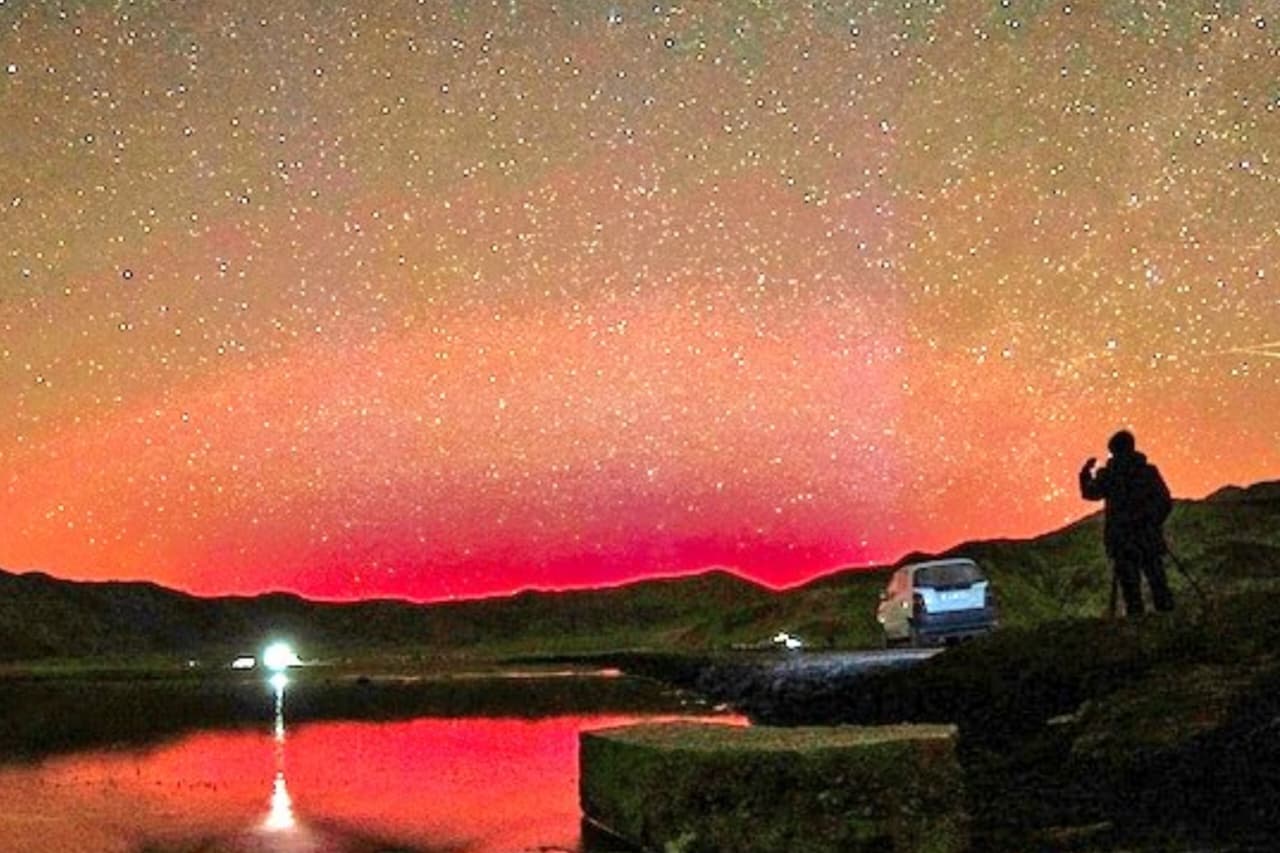
Recently, deep blood-red auroras lit up the skies over Hanle in Ladakh in a spectacular show that amazed both skywatchers and scientists. This strange event wasn’t caused by smog or dust in the air; it was caused by the sun being very active. It was one of the strongest space weather events since 2003.
What took place in the sky above Ladakh?
At the Hanle Dark Sky Reserve, the sky turned a bright red colour on the nights of January 19 and 20, 2026. Usually, the nights are dark and clear there. The Indian Astronomical Observatory’s all-sky cameras caught aurorae that went across the horizon. This is a very rare sight at this latitude.
The bright red colours came about when charged particles from the Sun hit Earth’s magnetic field and excited oxygen atoms high in the atmosphere. This made a steady auroral red arc, a type of aurora that you can usually only see near the poles.
Why was this solar storm different
The event started on January 18 with an X-class solar flare that sent a coronal mass ejection (CME), a huge cloud of magnetised plasma racing toward Earth. The particles hit Earth’s magnetosphere, which set off a G4-level geomagnetic storm. This was one of the biggest disturbances in space weather since the 2003 events.
The Reason for the Red Glow
Auroras happen when charged particles from the sun hit atoms in the high atmosphere of Earth. The more common green aurora is not seen very often at lower latitudes because of oxygen releases at higher elevations. This makes red auroras more common. That this event could be seen was made possible by Ladakh’s high elevation and dark skies.
Why scientists are paying close attention
Strong sun storms are more than just a natural show, even though they are beautiful to look at. Geomagnetic storms can mess up power lines, satellite communications, and navigation systems, which can be dangerous for modern technology and infrastructure.
Astronomers and people who study space weather stress how important it is to keep an eye on these events as the Sun gets closer to its solar maximum. This is when the Sun is most active in its 11-year cycle, which makes big flares and auroras more likely.
Read Also: What Viewers Discussed Today After Watching Anondi Drama