
Ports in Bengal have always risen and fallen with their rivers. The story of Tamralipta, one of the oldest ports in Bengal, and the later rise of Chittagong shows how a change in a river’s course could change the trade of a whole region.
Tamralipta: Bengal’s First Major Port
Tamralipta, also called Tamralipti, was an ancient port city on the coast of the Bay of Bengal. It was the capital of the ancient Suhma and Vanga kingdoms. The port stood on the right bank of the Rupnarayan River, near the meeting point of river and sea. Ancient texts and Chinese accounts describe it as a busy port, and scholars place its prime between roughly 200 BCE and 700 CE.
How Tamralipta Linked Bengal to the World
Goods and travellers moved from the Ganges plains down the rivers to Tamralipta and then by sea to Sri Lanka, Southeast Asia and beyond. A Buddhist traveller named Budhagupta most likely sailed down the Ganges and took a ship from here. The port helped build wealth and trading communities across ancient Bengal.
When the Rivers Changed Course
The decline came from changing rivers. The Saraswati used to flow into the Rupnarayan estuary. From around 700 CE, it moved eastwards and opened a new outlet near Sankrail, and Tamralipta began to lose its importance. Scholars also point to human causes, such as political disorder, taxes and foreign attack, along with silting and erosion. The Dudhpani rock inscription of the 8th century is probably the last record that mentions Tamralipta as a port.
Satgaon Takes Over in the West
In western Bengal, Satgaon, also called Saptagram, grew into the main port after Tamralipta faded. It later declined too, as the Saraswati silted up. After the Mughals took Hooghly in 1632, the customs office moved there. Tamralipta, Satgaon and then Calcutta each took their turn as the region’s principal port.
Harikela and the Rise of Chittagong
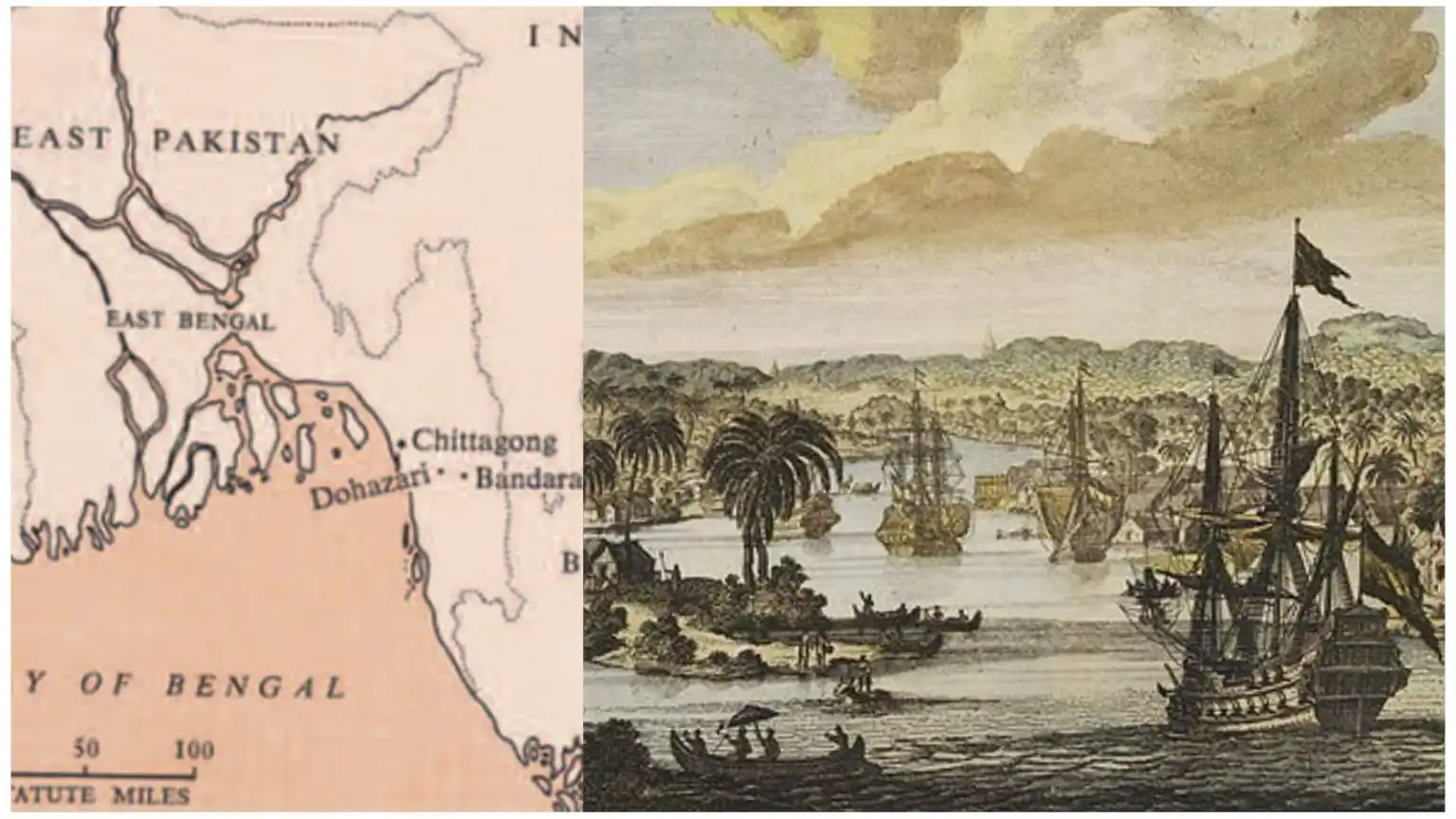
Far to the east, the Chittagong region belonged to Harikela, an ancient Buddhist kingdom. Harikela’s coastal location gave it a seaport, while neighbouring Samatata depended on a river port. Some historians note that after Samatata’s trade declined, trading networks shifted towards Harikela. Others say that between the 8th and 13th centuries, western Bengal had no major port, so Samandar, the Arab name for Chittagong, served as the entry and transit point. This is a historian’s interpretation rather than a proven cause.
Why Arab Merchants Chose Chittagong
Chittagong’s natural harbour sits a few miles inland from the sea, on the Karnaphuli River, which gave ships safe anchorage. It was not on the main ocean routes, yet it became a gateway for Arab merchants from the 9th century. Arab traders praised the region’s aloeswood, which was in demand in Persia and China. They also saw an established economy with currency, banking and shipping.
Samandar in Arab Records
Arab geographers called the port Samandar, and Arab traders used the name from around the 9th to the 14th century. One scholar identifies the island mentioned near it as Sandwip. In 1154, the geographer Al-Idrisi noted regular travel by merchants from Baghdad and Basra to Chittagong. Later, Ibn Battuta called it Sadkawan, and the Portuguese writer João de Barros described it as the most famous and wealthy city of Bengal.
Trade, Settlement and Islam
Arab and Persian traders did not only trade. Many settled in Chittagong, and Arab traders played an important role in spreading Islam in the region. Much of the local Muslim population is believed to descend from these settlers.
Chittagong Port Today
Chittagong, now Chattogram, remains Bangladesh’s main seaport and handles most of its export and import trade. The same river and harbour that drew Arab ships more than a thousand years ago still support the country’s trade.
What the Two Ports Teach Us
Tamralipta lost its place when its river moved. Chittagong gained from a stable natural harbour and from its position at the meeting point of Bengal, Arakan and the sea routes. The two stories show that a port survives only as long as its waters and trade routes stay open.