
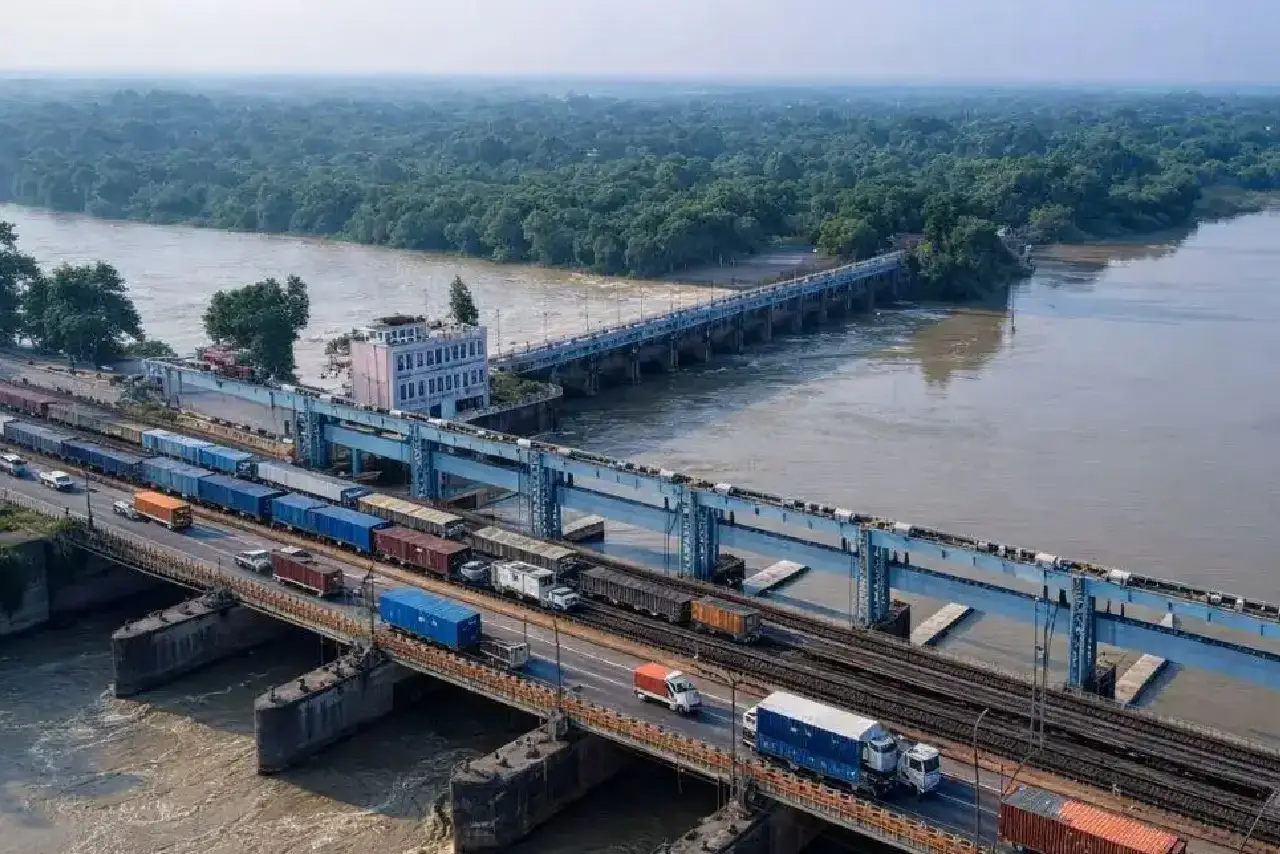
After more than six decades of studies, delays and false starts, Bangladesh has finally moved to build the Padma Barrage, one of the largest water infrastructure projects in the country’s history. The government’s Executive Committee of the National Economic Council approved the first phase of the project in May 2026, clearing the way for construction to begin on a structure planners say could reshape water security for a third of the country.
What The Project Actually Involves
The barrage itself will stretch 2.1 kilometres across the Padma River in Rajbari and Pabna districts, built with 78 spillways, 18 undersluice gates, two fish passes, a navigation lock, and guide and approach embankments. Once complete, it is designed to store 2,900 million cubic metres of water, enough to regulate dry-season flow across five major river systems, including the Gorai-Madhumati, Chandana-Barasia, Boral and Ichhamati-Mathabhanga systems. The plan also includes dredging 135.6 kilometres of the Gorai-Madhumati river system, re-excavating 246.46 kilometres of drainage channels, and building 180 kilometres of afflux embankments, alongside two hydropower plants with a combined capacity of 113 megawatts.
The first phase carries a price tag of roughly Tk 34,497 crore, funded entirely through the Bangladesh government’s own resources, and will benefit an estimated 19 districts and 120 upazilas across the Khulna, Dhaka, Rajshahi and Barishal divisions. Water Resources Minister Md. Shahiduddin Chowdhury Anee called it one of the most important projects for the nation, noting it would benefit around 70 million people once complete. The full project, including a second phase running from 2028 to 2034, is expected to cost close to Tk 50,443 crore and reach roughly 37 per cent of Bangladesh’s land area.
A Six-Decade Wait, And A Direct Response To Farakka
The Padma Barrage is not a new idea. Feasibility discussions date back to the 1960s, but the project never moved past the planning stage for decades. What gave it new urgency was a dispute that has shaped Bangladesh’s water politics for half a century: India’s Farakka Barrage.
Commissioned in 1975 on the Ganges in West Bengal, just upstream of the Bangladesh border, Farakka was built to divert water into the Hooghly River to keep Kolkata’s port navigable. For Bangladesh, sitting downstream, that diversion has meant sharply reduced dry-season flow reaching the country, contributing to what researchers describe as a slow-motion ecological crisis. A study by the River and Delta Research Centre found that 79 rivers in Bangladesh are now dead or dying, many of them dependent on Ganges flows, with Khulna division alone counting 25 such rivers. Bangladesh’s last Awami League government reported in 2024 that 308 rivers nationwide had lost navigability. The Padma Barrage is explicitly framed by planners as Bangladesh’s own engineering answer to that reduced flow, an attempt to store and manage what water does arrive rather than rely solely on cross-border negotiations.
The India Treaty Question Hanging Over The Project
The Padma Barrage’s timing is inseparable from a bigger deadline. The India-Bangladesh Ganges Water Treaty, signed on 12 December 1996 by then Indian Prime Minister H.D. Deve Gowda and then Bangladesh Prime Minister Sheikh Hasina, set a 30-year, formula-based framework for sharing dry-season water at Farakka. That treaty expires in December 2026.
The 1996 agreement was widely seen as a diplomatic breakthrough at the time, replacing years of ad hoc interim arrangements dating back to the 1950s. It set a ten-day sharing schedule for January through May based on historical flow data from 1949 to 1988, and built in emergency consultations if flows at Farakka drop below 50,000 cusecs. But its record since has been contested on both sides of the border.
Many in Bangladesh have long argued the treaty is biased toward India and has not delivered the water volumes it promised, particularly as climate change and upstream water use have reduced dry-season flows further. In India, the treaty faced political opposition too, with parties in West Bengal at various points accusing the government of sacrificing the state’s water interests, and West Bengal’s chief minister has previously raised concerns publicly about the arrangement.
With renewal talks now underway, both governments have signalled openness to revisiting the treaty’s terms. India’s Ministry of External Affairs has pointed to existing bilateral mechanisms covering 54 shared rivers between the two countries as the venue for addressing the issue, while Bangladeshi officials have linked the treaty’s renewal to the broader health of bilateral relations. Technical committees from both sides met in Kolkata in March 2026 as part of the ongoing Joint Rivers Commission process, though commentators on both sides note that the water dispute has grown more complicated than the original 1996 framework anticipated, involving not just how much water is shared but whether the Ganges basin itself can sustain current demands at all.
Discover More Stories Worth Your Time
How Will Bangladesh’s New Budget Affect Your Daily Expenses?
Learn which everyday essentials are becoming more expensive under the latest national budget.
How Can You Avoid Fake Overseas Job Offers?
Learn the safest ways to verify foreign job opportunities before paying any recruitment fees.
What Does the HSC 2026 Exam Suspension Mean for Students?
Get the latest updates on exam postponements caused by the ongoing flood crisis.
Why Are So Many Garment Workers Losing Their Jobs?
Understand the factors behind Bangladesh’s latest apparel industry layoffs.
Why Is Measles Making a Comeback in Bangladesh?
Discover what’s driving the outbreak and why health experts are concerned.
Why This Matters Beyond The Two Governments
For Bangladesh, the Padma Barrage represents an attempt to take a measure of water security into its own hands rather than depend entirely on the outcome of treaty renewal talks with India. For the roughly 70 million people the project is meant to serve, across a swathe of the southwest and north where dry-season rivers have run low for years, its success or failure will be felt directly in irrigation, fisheries, drinking water and the health of the Sundarbans delta. But engineers and environmental researchers have also cautioned that large barrages carry their own risks, including the possibility of starving the delta of the sediment it needs to keep pace with sea level rise and coastal erosion, meaning the project’s long-term impact will depend heavily on how carefully it is managed once built. With construction set to run through 2033 and the Ganges treaty renewal still being negotiated, the coming years will show whether Bangladesh’s own infrastructure and diplomacy with India can be made to work together, or whether they remain two separate, uneasy tracks
Summary: Bangladesh’s government has approved the first phase of the Padma Barrage, a Tk 34,497 crore mega-project meant to store dry-season water for a third of the country and roughly 70 million people. The project has been discussed since the 1960s and gained fresh urgency after India’s 1975 Farakka Barrage reduced downstream flows, a dispute that now converges with the looming December 2026 expiry of the India-Bangladesh Ganges Water Treaty.