
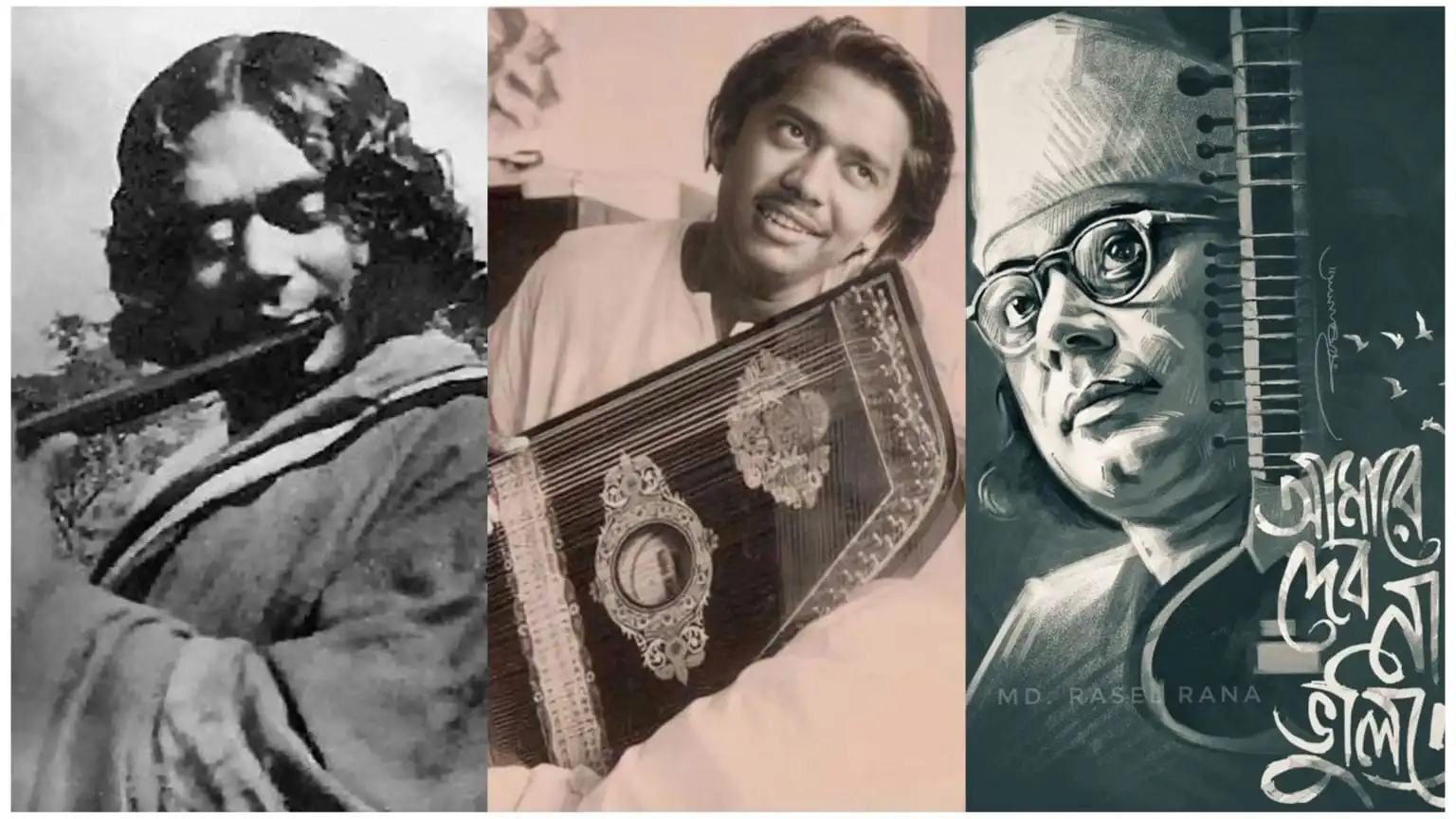
Kazi Nazrul Islam is best known as the Rebel Poet of Bengal, but he was also one of the most important bridges between Persian Sufi poetry and Bengali literature. Through his translations and his own ghazals, he gave Bengali readers and singers a taste of Hafiz, Rumi and Omar Khayyam in a form that felt local, musical and spiritual.
Persian and Sufi Poetry in Bengal Before Nazrul
Persian was part of Bengal’s cultural life for centuries. In many Bengali Muslim homes, the Diwan of Hafiz, Saadi, Khayyam or Rumi was a familiar book. Sufi saints who came to preach in the region also left a deep mark on Bengali folk poetry. Nazrul inherited this world, and he gave it a new voice in modern Bengali.
How Nazrul Learned Persian
Nazrul learned Arabic as a young boy. When he joined the army in late 1917, he learned Persian from a Punjabi moulvi in his regiment. He learned it well enough to translate Omar Khayyam and Hafiz. Many scholars say he translated directly from Persian, not through English versions.
The Poets Who Shaped Him
As a young reader, Nazrul read Tagore and Sarat Chandra Chattopadhyay, and also the Persian poets Hafiz, Rumi and Khayyam. He is described as a follower of Hafiz and Rumi, and his writing uses many Persian words that were already familiar in Bengali.
Rubaiyat-i-Hafiz
Nazrul’s Bengali version of Hafiz was published in Calcutta in 1930 as Rubaiyat-i-Hafiz. A research paper notes that he translated all 75 rubaiyat of Hafiz in the Bengali rubai form. Banglapedia says he translated Hafiz at the sickbed of his son Bulbul, at a time when he was turning towards spiritualism. Some sources list the work among his 1933 translations, so dates vary by source.
Rubaiyat-i-Omar Khayyam
Nazrul also translated Omar Khayyam’s rubaiyat from Persian. Scholars say his version kept the meter and rhyme of the original. One study notes that he sometimes gave the verses a more Indian flavour. Banglapedia lists it among his 1933 translations. Later editions came out afterwards.
Khayyam as a Sufi
Edward FitzGerald’s famous English version leans towards a sceptical, even atheist, reading of Khayyam. An Iranian study notes that Nazrul read him as a Muslim and a Sufi, and pointed to verses praising the Prophet as evidence of his belief in God.
Wine, Saki and the Sufi Reading
Persian ghazals are full of wine, the cupbearer (saki) and the tavern. A Daily Star essay explains that in Nazrul’s reading of the Sufi tradition these images were not about drinking and excess. Orthodox critics who took them literally, he felt, misunderstood Persian poetry. Wine stands for spiritual intoxication and the saki for a guide to divine love.
Creating the Bengali Ghazal
Nazrul did not stop at translation. He began writing ghazals in Bengali around 1927 and 1928, while living in Krishnanagar. Atulprasad Sen had written poems in this style earlier, but the Bengali ghazal is mainly Nazrul’s creation. His ghazals are structured like Urdu ghazals and are sung with or without tal, the rhythmic cycle.
Love, Longing and the Divine
Nazrul’s ghazals focus on love and longing, a very different mood from his revolutionary songs. Scholars say the two are two sides of youth. The ghazal’s language of the beloved allowed him to speak about human love and divine love at the same time, as Sufi poets always had.
Hafiz and Nazrul as Rebels
A comparative study notes that Hafiz and Nazrul share a rebellious spirit. Each criticised hypocrisy and rigid orthodoxy. It also says Nazrul was inspired by Hafiz’s ghazals and that his Hafiz is as original as the Persian poems, tinged with the taste of Bengali.
Ghazals on Record and Their Legacy
In 1933, Nazrul returned to the gramophone company HMV (His Master’s Voice) as its exclusive composer, and many of his songs were recorded. The Bengali ghazal served as the first mass-level introduction of Islamic themes into the mainstream tradition of Bengali music. His ghazals remain part of Nazrul Geeti today.
Why This Matters Today
Nazrul’s work shows Bengali literature has always been a meeting place of cultures. He was non-communal in his art, using Sanskrit, Arabic and Bengali metres with equal ease, and Persian and Hindu imagery in the same breath. For readers today, his Hafiz and Khayyam are a good way into Persian mysticism.