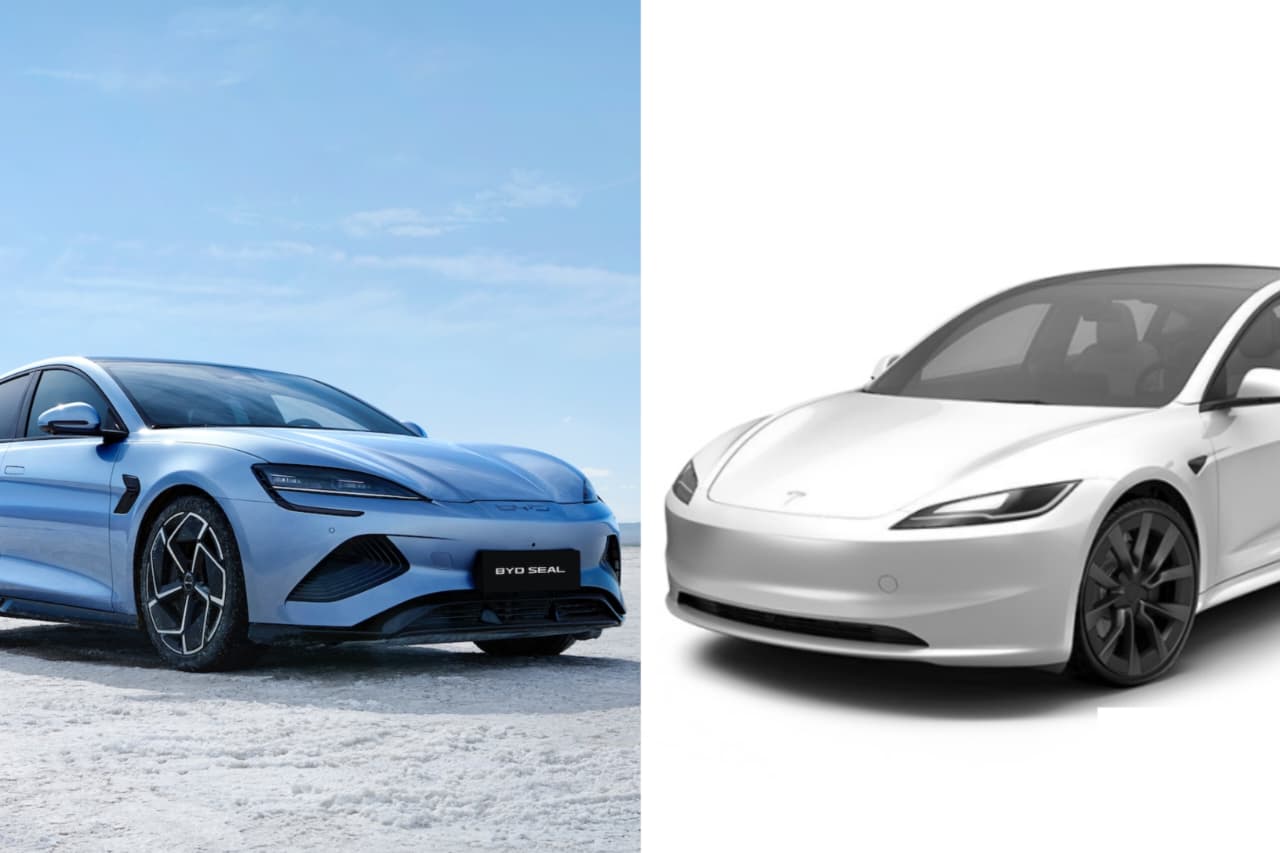
It has become increasingly difficult to find success in the competitive global electric vehicle market. The entry of new contenders or competitors into this arena has increased competition among the larger and more established manufacturers. Presently, one of the most hotly contested contests in the industry is between electric sedans BYD’s Seal and Tesla’s Model 3.
For a number of years, the Model 3 has been the best-selling premium electric sedan. However, due to its bold styling, impressive performance, and competitive price, the BYD Seal is quickly gaining market share. The following is a comparison of the two electric cars in terms of design and interior luxury.
Design and Interior Luxury
The BYD Seal is more of a conventional sedan, featuring dramatic curvatures and lines that are reminiscent of a luxury sports coupe and include a smooth and luxurious interior with modern aesthetics. The interior has been created with the comfort and use of premium materials in mind; for example, the vehicle comes equipped with a 15.6-inch rotating touchscreen, an ambient lighting option that allows the customer to select different colours, and a very large amount of space that resembles a more traditional luxury sedan.
On the other hand, the Tesla Model 3 has a very simplistic and minimalist style. The majority of the interior is dominated by a 15-inch touchscreen that governs most of the vehicle’s functionalities. Although the simplicity may be appealing to many technologically savvy customers, others may prefer the more conventional setup of the BYD Seal.
Battery, Range, and Charging
One of the most significant aspects for EV purchasers to consider is the range.
The Tesla Model 3 Long Range is capable of travelling up to 660 km (according to the worldwide harmonised light vehicle test procedure – WLTP), whereas the BYD Seal can travel between 480 and 570 km, depending on which of its variants purchasers select.
When it comes to fast charging, the Tesla Model 3 Long Range has up to 250 kW DC fast charging capacity, compared with the BYD Seal’s 150 kW DC fast charging capability.
Additionally, whereas Tesla uses lithium-ion technology, Byd’s Seal employs Blade Battery technology, which optimises performance by providing increased safety and durability through the use of lithium iron phosphate (LFP) as a cathode material.
Drive quality and overall performance are both excellent with any EV
If comparing the BYD Seal Performance AWD and the Tesla Model 3 Long Range in a straight-line acceleration race, the BYD Seal will complete 0 – 100 km/h in 3.8 seconds using up to 530 hp; whereas the Tesla Model 3 Long Range will complete 0 – 100 km/h in around 4.4 seconds using up to 490 hp. While the BYD Seal can accelerate slightly faster in some configurations, the Tesla Model 3 Long Range takeaway is their next-gen software programming, advanced assistive-driving technologies, and exceptional road performance.
Moreover, typically, one benefit of purchasing products from BYD is that customers will typically pay a much lower price than what is being asked for by Tesla. As at the time of writing, the Tesla Model 3 ranges from about $39,000 – $51,000 depending on your option choices, while the BYD Seal retails for approximately $26,000 – $39,000 in numerous regions of the globe.
Because of the cost difference of purchasing the BYD Seal compared to the Tesla Model 3, the BYD Seal provides EV buyers with premium-quality EV features and equipment without the premium-price associated with the Tesla Model 3.
FAQs
1. Which car has a longer range: BYD Seal or Tesla Model 3?
The Tesla Model 3 Long Range offers up to about 660 km, while the BYD Seal provides around 480–570 km depending on the variant.
2. Is the BYD Seal faster than the Tesla Model 3?
Some performance versions of the BYD Seal can accelerate from 0–100 km/h in about 3.8 seconds, slightly quicker than many Model 3 variants.
3. Which EV is cheaper?
The BYD Seal is generally more affordable than the Tesla Model 3 in most markets.
4. Which car charges faster?
The Tesla Model 3 supports faster DC charging (up to 250 kW), while the BYD Seal supports around 150 kW.
5. Which electric sedan is better overall?
The Tesla Model 3 leads in technology and charging infrastructure, while the BYD Seal offers excellent performance and value for money.
Read Also: When Will Banks Reopen in Rangpur After Eid-ul-Fitr?