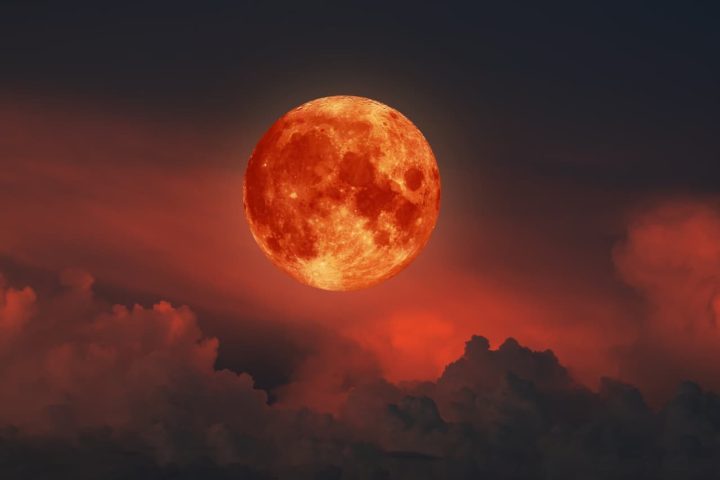
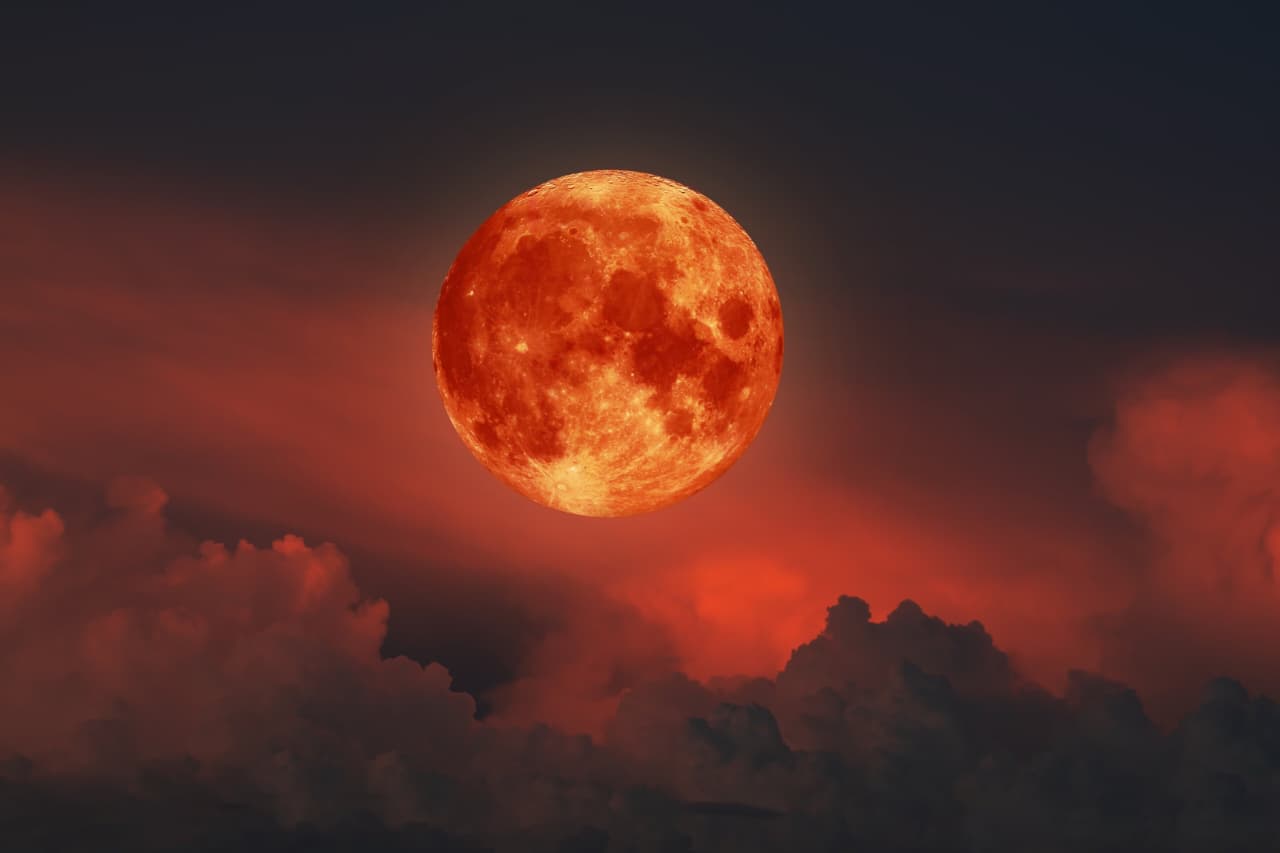
One of the most spectacular events visible on the earth is a total lunar eclipse commonly referred to as a Blood Moon. A lunar eclipse is perfectly visible to the naked eye compared to a solar eclipse where one needs some special eye protection. But what is occurring in the case of a Blood Moon, then why is the Moon red?
What Is a Total Lunar Eclipse?
The entire lunar eclipse is the situation when the earth passes between the sun and the moon, and a shadow is provided to the entire hill. This is possible only at full moon when the Sun, the Earth and the Moon are in a straight line.
The Moon goes through two regions of the earth shadow – Penumbra and Umbra. Penumbra occurs when the more light there is on the external bit of the shadow. The darkening is tender and very difficult to observe. While in Umbra the earth shadow is taken in the middle and lesser darker portion. Once the moon is completely within the umbrella, totality kicks off and at this point, the Blood Moon happens.
Why Does the Moon Turn Red?
When there is a totality, the Moon does not absolutely disappear. Rather, it is lit in copper, orange, or deep red. This is so due to what is known in science as Rayleigh scattering.
The atmosphere of the earth is able to select the sunlight as it is moving through the planet. The longer wavelengths of light bend and extend to the moon (blue), whereas shorter wavelengths of light (red) scatter in various directions. The result? This red light is reflected by the Moon on the Earth and the well-known Blood Moon is formed. And that is the same reason why the sunsets are red or orange.
Stages in Eclipse of the Moon.
Depending on the alignment, the totality phase may take several minutes; it might also take just more than an hour. A complete lunar eclipse occurs in a number of phases. These phases are as follows:
Penumbral Eclipse Begins – Its outer shadow on earth is entered by the Moon. Slight dimming begins.
Partial Eclipse – The Moon starts flying into the shadow. A dark “bite” appears.
Totality (Blood Moon) – The whole Moon is contained in the umbra and it becomes red.
Partial Eclipse Ends – The Moon exits the umbra.
Penumbral Eclipse Ends – The Moon totally comes out of the shadow of the Earth.
Is There a Reserve of Blood Moons?
Lunar eclipses occur in the superior number of every 2-3 yearly at a certain position, whereas diverse lunar eclipses can take place around the world within a year. All full moons do not necessarily lead to an eclipse since the orbit of the Moon is slightly inclined to the orbit of the Earth around its Sun.
Official Source Links
FAQs
1. What causes a Blood Moon?
The Blood Moon is the occurrence during a complete lunar eclipse, when the atmosphere of the Earth supplies the sunlight to the Moon and it turns red.
2. Gazing at a lunar eclipse: is it safe?
Yes. In contrast to the solar eclipses, the lunar eclipses can be viewed without the use of protection glasses.
3. How much time does a Blood Moon take?
Totality may be a couple of minutes or even more than an hour depending on the alignment.
4. Does the Bloomoon possess a special significance?
It is merely a natural astronomical phenomenon medically which is brought about by the shadow of the earth. Differences exist in the cultural interpretations across the globe.
Read Also: Real Madrid vs Getafe Match Report: Goals, Highlights & Player Ratings