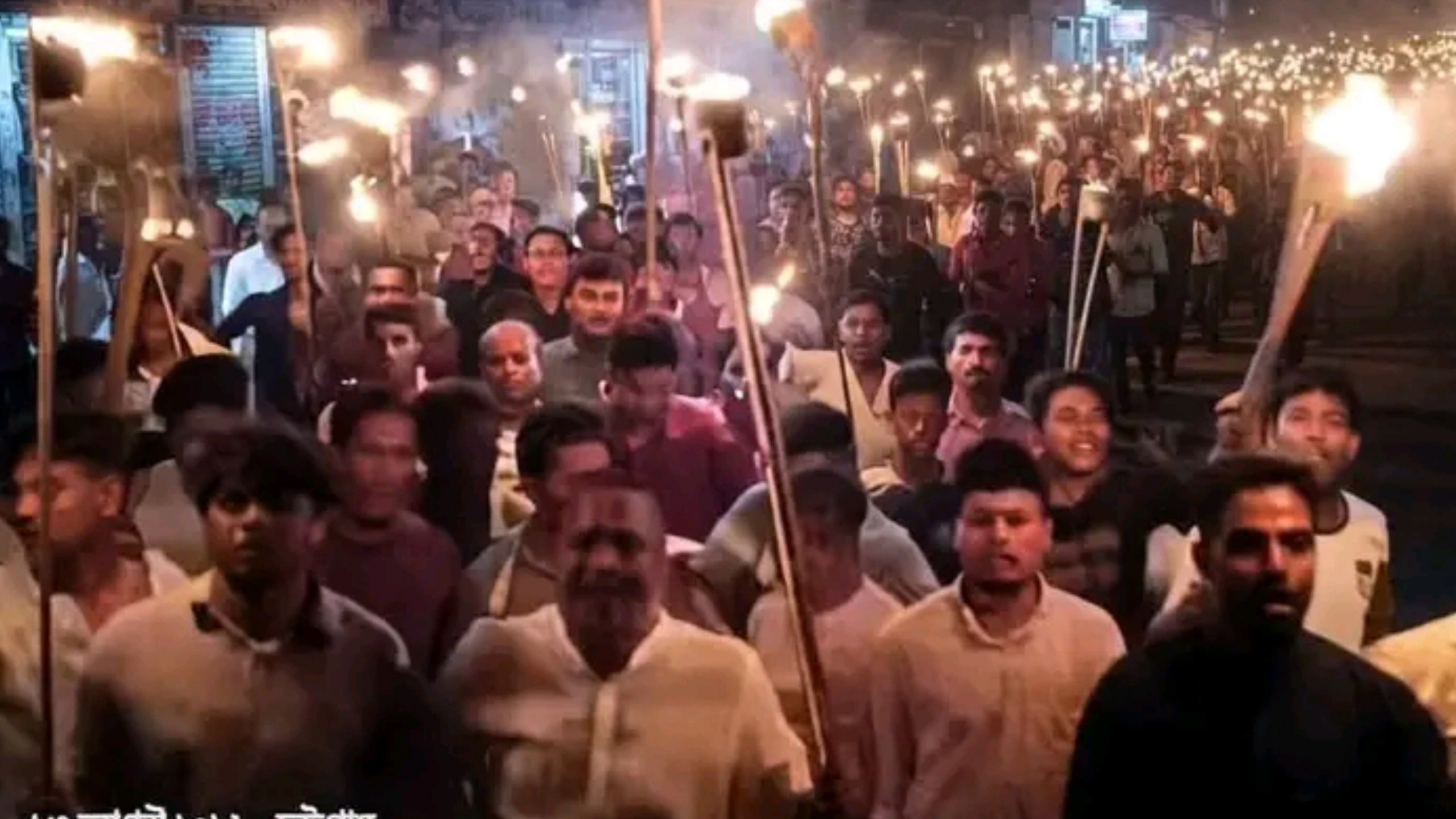
A torchlit procession in Bangladesh’s Banshkhali has brought renewed attention to the activities of the Awami League at a time when the party’s political operations remain restricted. A nearly four-minute video showing dozens of people carrying flaming torches and chanting pro-Awami League slogans has rapidly circulated on social media, raising questions about how much organisational strength the party still retains outside the public eye.
According to reports published on August 14, the procession took place on Thursday night, August 13, in the Chunti Bazar area of Baharchhara Union in Chattogram’s Banshkhali. Reports differ slightly on the number of participants, with estimates ranging from around 40 to 60 people. The video shows participants marching with torches, chanting slogans and later delivering speeches.
The most significant aspect of the incident may not be the size of the gathering but the fact that it happened at all.
A sign of an underground network?
When a major political organisation is unable or unwilling to operate openly, its local networks do not necessarily disappear overnight. They can become less visible, relying on personal connections, private meetings and sudden flash demonstrations.
The Banshkhali procession could therefore indicate that sections of the Awami League’s grassroots structure remain active. However, it would be premature to conclude from a single video that the party has rebuilt a nationwide underground organisation. The identities of those appearing in the footage and the exact size and organisational structure behind the procession have not been independently established.
What the footage does demonstrate is the ability of a group of supporters to assemble, coordinate a procession and produce material designed for rapid circulation online.
Why the torch rally matters
Torch processions carry a strong political symbolism. Conducting one at night allows participants to create a visually powerful image while limiting the duration of their physical presence. This can make a flash demonstration easier to organise and harder for authorities to anticipate.
The Banshkhali video also appears to have been recorded with social media in mind. Once uploaded, a small local demonstration can reach audiences far beyond the location where it occurred.
That changes the purpose of a protest. It is no longer simply about the number of people physically present. It can also be about demonstrating that supporters remain mobilised.
The slogans reported from the procession were explicitly political, including calls supporting Sheikh Hasina and rejecting the legitimacy of the current government.
The timing is equally important
The incident comes amid reports of other flash activities involving Awami League and former Chhatra League supporters. Reports said a separate procession involving banned Chhatra League activists had taken place near the Taylar Dweep Bridge area of Banshkhali just a day earlier.
If independently verified, two consecutive incidents would suggest that political mobilisation in the area may not be an isolated occurrence.
At the same time, the available evidence does not establish that the two events were centrally coordinated. That distinction matters. A resilient grassroots network can exist without proving the existence of a command structure operating nationally.
Find Which Airport Hotels Fit?
Discover convenient hotels near Dhaka Airport for short layovers and overnight stays.
Learn How Rohingya Youth Lead?
Explore how young Rohingya are advancing education and gender equality in refugee camps.
Find Which Airport Hotels Fit?
Discover convenient hotels near Dhaka Airport for short layovers and overnight stays.
Learn How Rohingya Youth Lead?
Explore how young Rohingya are advancing education and gender equality in refugee camps.
Social media has become the new political battlefield
The viral video also highlights a broader transformation in Bangladeshi politics. Political activity that once depended on rallies, party offices and public meetings can now be projected through short videos.
For an organisation facing restrictions, this creates a relatively low-cost way to communicate with supporters. A few minutes of footage can send several messages at once: supporters are still present, local networks remain connected, and political slogans have not disappeared.
But viral footage can also exaggerate perceptions. A crowd of several dozen can appear much larger after repeated sharing, editing and commentary. That is why the video should be treated as evidence of a specific mobilisation rather than proof of the Awami League’s overall strength.
What happens next?
The police response will be crucial. Banshkhali police said they were examining the video and that efforts were continuing to identify those involved.
For authorities, the challenge is to distinguish between isolated political expression, organised mobilisation and any activity that violates existing restrictions. For the Awami League, meanwhile, the incident could be seen as evidence that its grassroots supporters have not simply vanished from Bangladesh’s political landscape.
The Banshkhali torch rally therefore tells a more complicated story than a viral video alone might suggest. It does not prove that the Awami League has built a powerful underground movement. But it does show that, even under political restrictions, parts of its local support network can still emerge, organise and make themselves visible.
The real question is whether Banshkhali represents a one-off flash of resistance—or an early glimpse of a broader underground political strategy.