
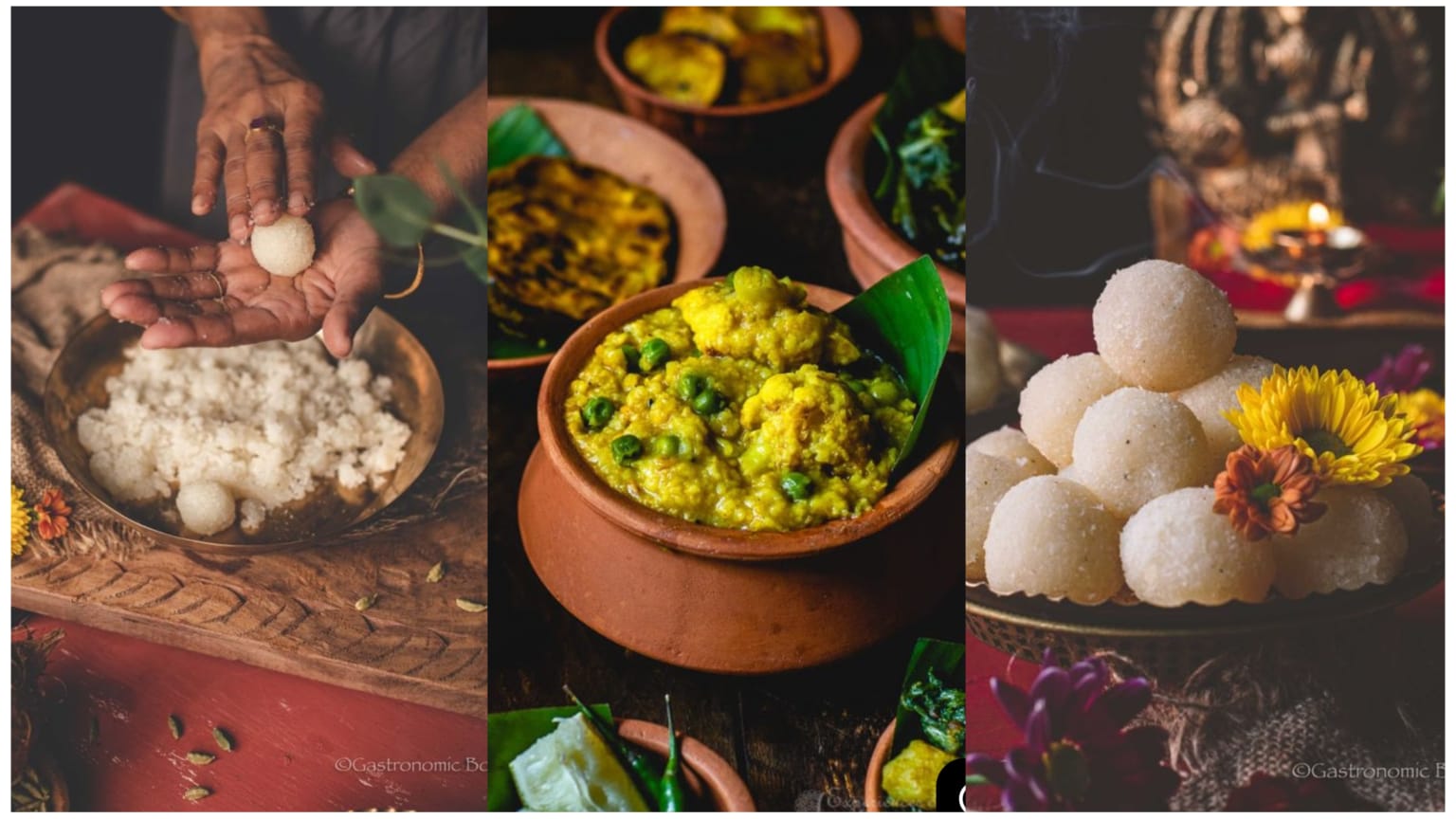
Vijaya Dashami 2026 fell on 20 October, but in Bengali homes, the festive mood does not end with the immersion. Bijoya Dashami means hugs, blessings, and plates of sweets passed around for days. Neighbours drop in, and elders get a pranam. Every visitor leaves with something sweet in their mouth.
This guide gives you 10 easy Bengali recipes for Bijoya. It starts with the comfort of bhoger khichuri and spends the most time on the sweets people wait for all year: narkel naru, chandrapuli, and puli pithe.
Why Sweets Matter on Bijoya
After the Puja, Bijoya is the time to forgive, bless, and reconnect. Offering sweets is how Bengalis say “let us start fresh.” Most of these sweets are made at home with coconut, jaggery, rice flour, and milk, so they are simple, affordable, and full of memories.
1. Bhoger Khichuri
No Puja feels complete without it. This is the soft, golden khichuri served as bhog, and it is gentler than the everyday version.
Ingredients: 1 cup gobindobhog rice, 1/2 cup roasted moong dal, 1 tsp ginger paste, 1 tsp cumin seeds, 2 bay leaves, 1/2 tsp turmeric, 2 tbsp ghee, cauliflower, potato and green peas, salt, and a pinch of sugar.
Method: Dry roast the moong dal until it smells nutty. Wash the rice and dal together. Heat ghee, add cumin, bay leaves, and ginger, then fry the vegetables lightly. Add rice, dal, turmeric, salt, sugar, and 4 cups of hot water. Cook until soft and porridge-like. Finish with a spoon of ghee.
2. Narkel Naru
This is the star of Bijoya. These round coconut laddus are made in almost every Bengali home, and they are very forgiving for beginners.
Ingredients: 2 cups freshly grated coconut, 3/4 cup sugar or grated jaggery, 1/4 cup milk, 1/2 tsp cardamom powder, 1 tsp ghee.
Method:
- Cook the coconut and sugar on low heat, stirring often, for about 10 to 12 minutes.
- Add milk and ghee, and keep stirring until the mixture leaves the sides of the pan.
- Add cardamom and let it cool slightly.
- Grease your palms with ghee and shape the warm mixture into small balls.
Tip: Do not overcook. A dry mixture gives hard naru. Pull it off the heat while it is still slightly moist.
Gur Narkel Naru: Use date palm jaggery (nolen gur) in winter for a deeper, caramel-like taste. This version is a Bengali favourite.
3. Chandrapuli
Chandrapuli is a half-moon-shaped sweet. Its name comes from “chandra,” meaning moon. It is crisp outside and soft, milky, and coconutty inside.
Ingredients for the filling: 1 cup grated coconut, 1/2 cup khoya or milk powder, 1/3 cup sugar, 1/2 tsp cardamom powder.
Ingredients for the covering: 1 cup maida (refined flour), 2 tbsp semolina, 2 tbsp ghee, a pinch of salt, water as needed, and oil or ghee for frying.
Method:
- Cook the coconut, khoya, and sugar until thick and dry. Add cardamom and cool.
- Knead a firm dough with maida, semolina, ghee, salt, and water. Rest it for 20 minutes.
- Roll small rounds, place a spoon of filling in the centre, fold into a half-moon, and seal the edges well.
- Fry on low to medium heat until light golden.
Tip: Press the edges firmly or crimp them with a fork so the filling does not leak into the oil.
4. Puli Pithe
Puli pithe is a winter special, but many families make it for Bijoya too. These are soft rice flour dumplings filled with a sweet coconut mixture. They are boiled in thickened milk and sweetened with jaggery or sugar.
Ingredients for the filling: 1 cup grated coconut and 1/2 cup nolen gur or jaggery, cooked until thick.
Ingredients for the dough: 1 cup rice flour, 1 cup hot water, a pinch of salt, and 1 tsp ghee.
For the milk: 2 cups full-cream milk, 3 tbsp sugar, and 2 cardamom pods.
Method:
- Make a smooth, soft dough with the rice flour and hot water.
- Shape small cups, fill each with the coconut mixture, and close into an oval or a ball.
- Boil the milk with sugar and cardamom until it thickens a little.
- Gently drop in the pithes and simmer for 10 minutes.
Serve warm or cold. Many people prefer it after a night in the fridge, when the milk has soaked in.
5. Nimki
Every Bijoya plate needs something crunchy. Nimki is a thin, diamond-shaped fried snack flavoured with kalonji (nigella seeds). It balances all the sweetness on the table.
Mix 1 cup maida, 2 tbsp ghee, 1/2 tsp kalonji, and salt. Knead a stiff dough, roll it thin, cut into diamonds, and fry on low heat until crisp. Cool completely before storing in an airtight box.
6. Payesh
Bengali payesh is a creamy rice kheer. Slow-cooked gobindobhog rice meets full cream milk, and the result is rich and fragrant.
Boil 1 litre milk until it reduces by one third. Add 1/4 cup washed rice, and cook on low heat until soft. Add sugar or nolen gur, a bay leaf, and cardamom. For best results, add the gur after turning off the heat so the milk does not split.
7. Malpua
Malpua is a sweet pancake fried in ghee and dipped in sugar syrup. It is often served with rabri, though plain malpua is just as loved.
Mix 1 cup maida, 1/2 cup milk powder, 1/2 cup milk, 1 tsp fennel seeds, and a little water into a thick batter. Rest it for 30 minutes. Fry small rounds in ghee until the edges are crisp, then soak them briefly in warm sugar syrup.
8. Gokul Pithe
This is another loved Bengali pithe. Fried dumplings with a coconut and khoya filling are soaked in sugar syrup. They are crisp outside and juicy inside.
Prepare a filling of coconut, khoya, and sugar, shape it into small balls, and coat them with a thin batter of maida and milk. Fry until golden and soak in light syrup for a few minutes.
9. Sandesh
For many Bengalis, Bijoya is not complete without sandesh. It is simple, milky, and not too sweet.
Curdle 1 litre of full cream milk with lemon juice. Drain the chhena and knead it for 5 to 7 minutes until smooth. Cook it with 3 tbsp sugar on low heat for 2 to 3 minutes. Cool a little, shape it, and press a cardamom seed or pistachio on top.
10. Ghugni
Ghugni gives you a salty, spicy break among all the sweets. Made with dried yellow peas, it is a classic Bengali comfort snack.
Soak 1 cup dried peas overnight and pressure cook with salt and turmeric. Temper with cumin, bay leaf, ginger, green chilli, and chopped onion. Add the peas, a little garam masala, and cook until thick. Top it with chopped onion, coriander, and a squeeze of lemon.
Quick Tips for Perfect Bijoya Sweets
- Use fresh coconut whenever you can. Packaged coconut often gives dry results.
- Stir coconut sweets on low heat so they do not burn.
- Use ghee generously on your palms when shaping naru.
- Store coconut sweets in the fridge and eat within 3 to 4 days.
- Make fillings a day ahead to save time on the busy day.
Sample Bijoya Platter
If you plan to host guests, a balanced plate could include narkel naru, chandrapuli, puli pithe, sandesh, nimki, and a small bowl of ghugni. This gives your visitors a mix of soft, crisp, creamy, and spicy, so everyone finds something they like.
Final Thoughts
Bijoya is about people more than food, but the food is how Bengalis show love. Pick two or three of these recipes if you are short on time, or cook the whole menu if you have a full house. Either way, a plate of homemade narkel naru and chandrapuli will make your Shubho Bijoya warmer.
Discover More Stories About Durga Puja
1. Who started the famous Durga Puja tradition in Taherpur, Bangladesh?
According to traditional historical accounts, Raja Kangsanarayan Roy organised Sharadiya Durga Puja in Taherpur around 1480 AD. Read more about the history of Raja Kangsanarayan and Taherpur Durga Puja.
2. What is the significance of Mahalaya in Durga Puja?
Mahalaya marks the beginning of the festive countdown to Durga Puja for many devotees. It is associated with devotional hymns, Agomoni songs, and the invocation of Goddess Durga. Explore the significance of Mahalaya 2026, its hymns, and Agomoni songs.
3. How much rice has been allocated for Durga Puja mandaps in Rajshahi in 2026?
The government allocated 289 tonnes of rice for 489 Durga Puja mandaps across Rajshahi district in 2026. Each mandap was allocated 600 kg of rice. Read more about the rice allocation for 489 Durga Puja mandaps in Rajshahi.
4. What are Agomoni songs, and why are they associated with Durga Puja?
Agomoni songs are traditional Bengali devotional songs welcoming Goddess Durga to her parental home. They express devotion, anticipation, and the emotional bond between Durga and her mother, Menaka. Learn more through this guide to Mahalaya hymns and Agomoni songs.
5. Why is Taherpur important in the history of Durga Puja in Bengal?
Taherpur is associated with a centuries-old tradition of autumn Durga Puja linked to Raja Kangsanarayan Roy. Its historical and religious significance makes it an important part of Bengal’s Durga Puja heritage. Discover more about Taherpur’s Durga Puja history and Raja Kangsanarayan.