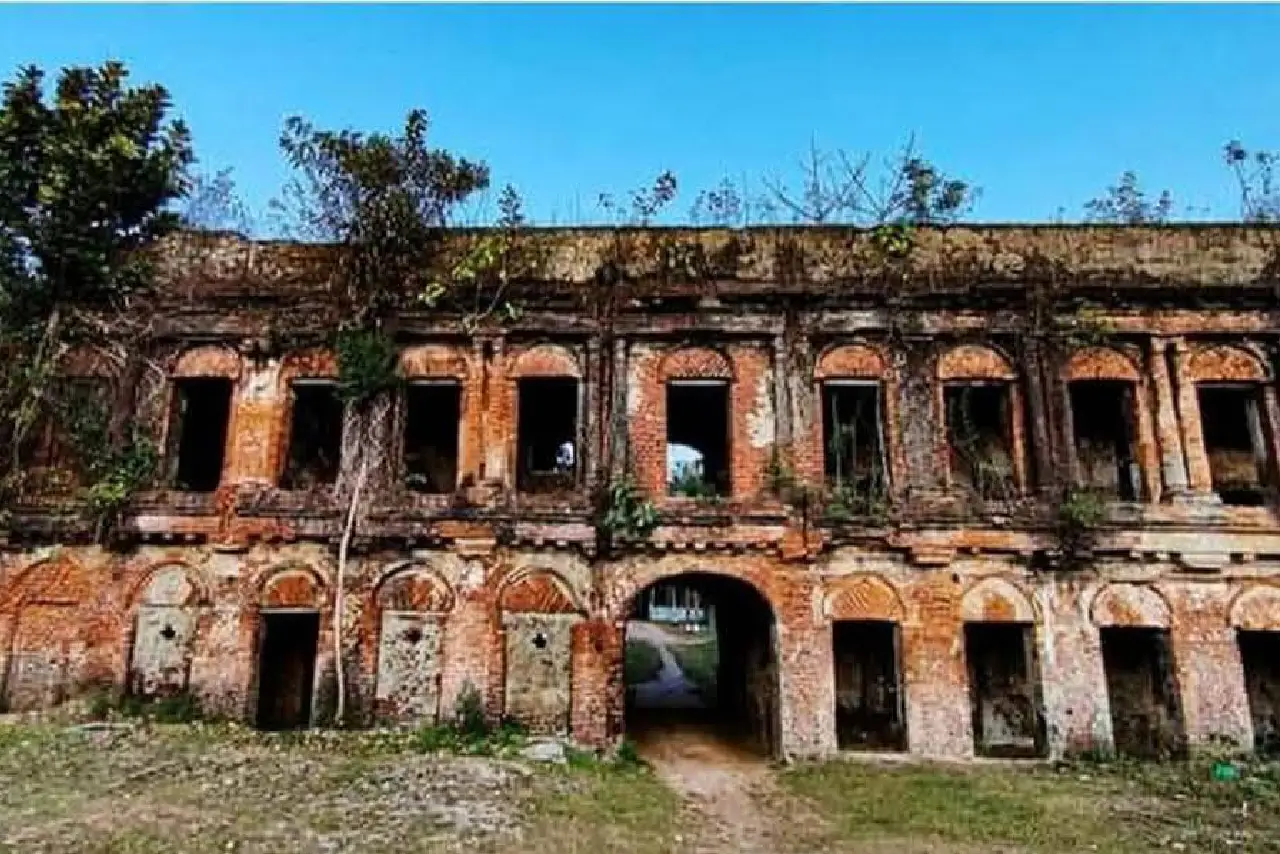
Long before Bangladesh was the country it is today, the land was dotted with the grand estates of zamindars, the powerful landowners who managed vast territories under Mughal and later British colonial rule. Many of their mansions, once filled with music, feasts and political intrigue, now stand hollow, half-swallowed by vines. Locals say some of them are not empty at all. “These walls remember everything that happened inside them”
This is how many villagers living near old rajbari sites describe their local ruins. The fall of zamindari estates in 1950, the Partition, and decades of neglect have reduced these once bustling households into skeletons of their former selves. What remains is a strange mix of architectural beauty and unsettling quiet, the kind that makes a visitor lower their voice without intending to.
Natore Rajbari and the murmurings of an incomplete legacy
The Rajbari complex at Natore is one of the largest zamindar estates in Bangladesh. It was built by the landed families of the Baro Bhuiyan times and later expanded by Rani Bhabani, a name revered still in Rajshahi division. The size of the estate is disconcerting enough at nightfall, with a number of empty rooms, staircases that go nowhere useful, and courtyards in which the wind appears to blow differently than it ought.
Local custodians and elderly residents often speak of inexplicable footsteps echoing through empty corridors at night and lights flickering in parts of the palace that have not been connected to the electricity grid for years. Are these genuine paranormal experiences or simply old buildings settling with age? That is for the visitor to decide.
Stone Temples and Tales of Misrule, Puthia Rajbari
Puthia is known as the temple town of Bangladesh and has one of the most photographed zamindar complexes of the country. Its Shiva temple and Govinda temple are marvels of terracotta artistry, but the palace itself has a heavier atmosphere. Local stories talk of a zamindar family, wiped out by rivalry and early deaths, and a house where doors are reported to open on their own and cold drafts blow through rooms with no windows nearby.
- The temple complex at Puthia is one of the best preserved Hindu architectural sites in Bangladesh.
- The main palace building has been partially restored, but large parts are still closed to the public
- Local guides often tell of strange sounds near the old zenana quarters, the private living area once reserved for women of the household
Dighapatia Palace and the hush after grandeur
Dighapatia Rajbari in the Natore district is now a government facility, but its older wings have a haunting quality that history alone cannot dispel. During its zamindari years, the palace was known for its hospitality and played host to several notable figures of colonial Bengal. Much of the family’s wealth and presence disappeared almost overnight after partition, and locals say the suddenness of that departure left something behind. “You can feel the difference the moment you step past the old gate”
Those who work in the newer government offices built next to the historic parts often describe an odd shift in atmosphere between the two, one modern and functional, the other still, but in a way that seems deliberate, not just empty.
Why These Stories Endure
Bangladesh’s rich oral tradition of storytelling does much to keep the legends alive from one generation to the next. Some common threads emerge from most haunted rajbari stories:
- Unexpected family tragedies or unresolved inheritance conflicts
- Sudden departures during partition or the abolition of the zamindari system
- Long neglect which let folklore grow unchallenged
Architectural features such as hidden passages, old wells and zenana quarters that naturally lend themselves to mystery
These mansions are a glimpse of a social order vanished, if you love history. For those interested in the supernatural, they offer an atmosphere that is hard to find anywhere else in the country. Either way, a visit to any of these estates is as much about confronting history as it is about testing your nerve after sundown.
The tales of Bangladesh’s vanishing zamindar mansions are far from over. Whether due to real paranormal activity or simply the natural byproduct of grand history left to decay, these estates remain some of the most atmospheric and culturally significant sites in the country, worth visiting for the architecture alone, and worth remembering for everything that came before it.
Summary
Bangladesh’s abandoned zamindar mansions hide centuries of wealth, tragedy, and folklore. This piece explores the eerie legends and real history behind these crumbling estates that still draw curious visitors and ghost hunters alike.