
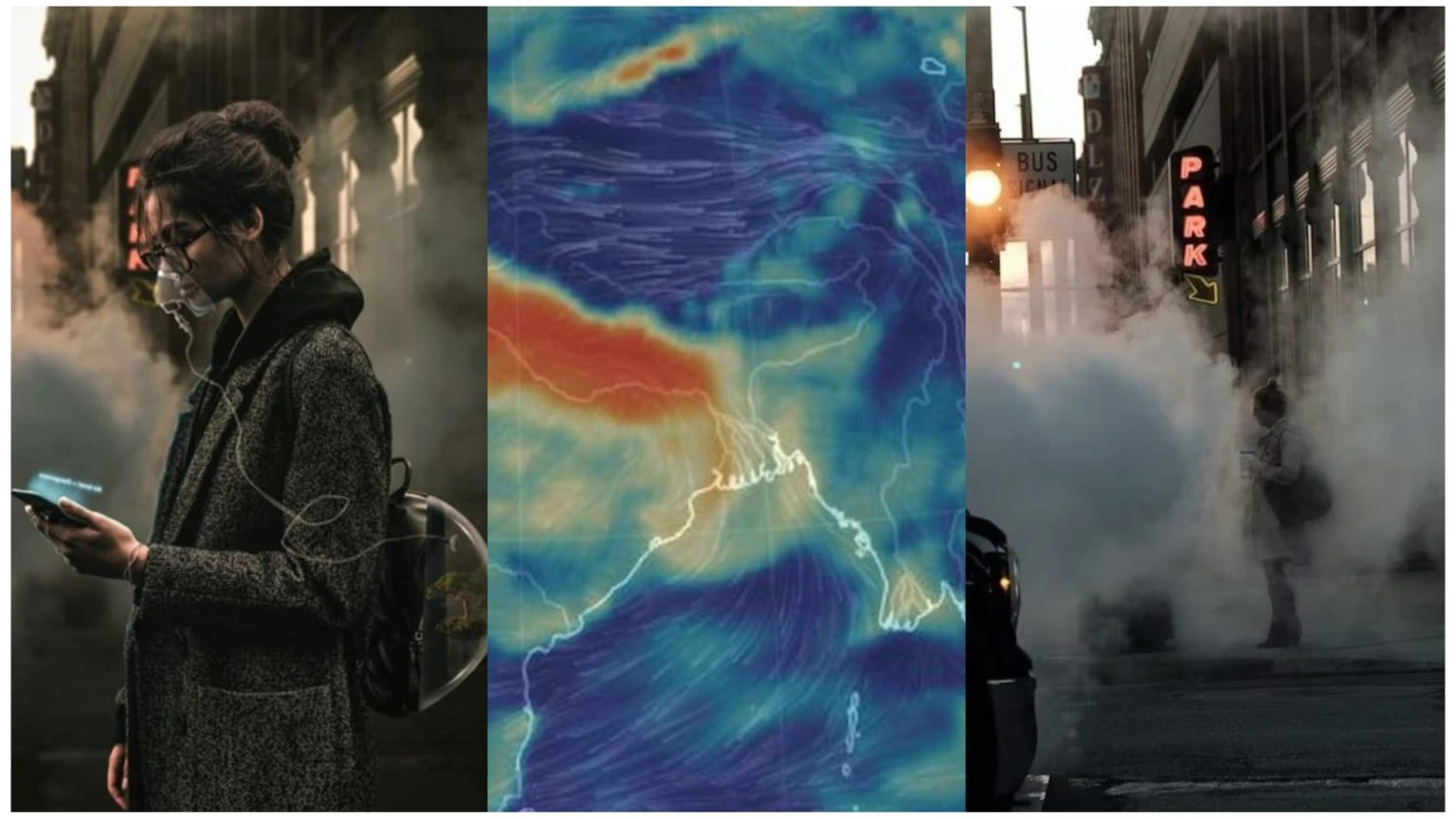
The latest NASA image shows a wide grey haze lying across the Indo-Gangetic Plain, running through Punjab, Haryana, Rajasthan and Uttar Pradesh and stretching toward eastern India. Red markers show fires on farmland, where crop residue is burned after harvest.
In Delhi, the air quality index reached 376 on Diwali, the worst Diwali reading in five years, as firecrackers and farm smoke mixed with cold, still winter air.
For readers in Bangladesh, the image is more than distant news. The country sits at the eastern edge of the same plain, and winter weather affects the whole region at once.
Dhaka’s Own Numbers Tell the Story
Dhaka’s air has been poor for weeks. The capital scored 213 on 6 October and ranked first among the world’s most polluted cities that day. On 6 November it hit 203, classed as very unhealthy. A day later it stood at 189, and on 8 November it recorded 182 and ranked fourth worldwide, behind Lahore, Delhi and Kolkata.
The problem is not limited to the capital. The Department of Environment’s report for 26 October showed unhealthy air in Chattogram at 163, Gazipur at 160, Narayanganj at 176, Mymensingh at 184, Barishal at 157 and Cox’s Bazar at 160. A department official told BSS that air quality worsens in the dry season because of the change in weather patterns after the monsoon.
What Is Making Bangladesh’s Air Worse
Much of the pollution is homegrown. Vehicle exhaust, construction dust, industry, brick kilns and burning of waste and household fuels are commonly cited sources. A satellite-based study covering 2005 to 2018 found that Bangladesh had the largest share of premature deaths linked to fossil fuel combustion in South Asia, at 36.5 percent, ahead of India at 30.7 percent. UNICEF has also noted that Bangladesh carries one of the largest burdens of child deaths linked to indoor air pollution, and the government’s clean cooking plan aims for 100 percent clean cooking solutions by 2030.
Why Borders Do Not Stop Smoke
Wind carries fine particles over long distances, which is why the same winter haze shows up over Lahore, Delhi, Kolkata and Dhaka around the same weeks. Air quality scientist Pallavi Pant has called air pollution a regional challenge that needs a consistent, coordinated approach across South Asia, not just between two neighbours.
There is a data problem too. Most low and middle income countries have fewer than one ground monitor per million people. Satellites can help by tracking smoke plumes across political boundaries, and organisations such as ICIMOD and NASA are already training regional experts to use satellite data for air quality forecasts up to 48 hours ahead.
What Cooperation Could Mean for Bangladesh
Experts suggest practical steps rather than grand treaties. Sharing real-time monitoring data between countries, building joint forecasting systems, and supporting cleaner fuels and cooking technology would all help. Cities, universities and research institutes can also trade data and lessons directly. South Asia has talked about this for years, including the 1998 Male Declaration on air pollution, but follow-through has been weak.
For Bangladesh, a seat at that table matters. A country that lives downwind and also has its own serious emissions problem has a strong case for both asking for cooperation and offering it.
What Readers Can Do Now
On bad air days, health experts generally advise limiting outdoor activity, wearing a well-fitted mask when outside, and keeping windows closed during peak pollution hours. Children, older people and those with asthma or heart conditions need extra care.
The satellite image makes a simple point: South Asia breathes one shared sky. Cleaning Dhaka’s air will need action at home, and it will also need neighbours who are willing to work together.
What is a healthy AQI?
Under the Department of Environment scale, 0 to 50 is good, 51 to 100 is moderate, 101 to 150 is unhealthy for sensitive groups, 151 to 200 is unhealthy, 201 to 300 is very unhealthy and above 300 is hazardous.