
Every morning, bins in Dhaka fill up, rickshaw vans roll through the lanes, and by noon the rubbish seems to have vanished. But “gone” is not the same as “solved.” Thousands of tonnes of waste leave Dhaka’s homes and markets every day, and most of it ends up in two overloaded dumps at the edge of the city.
The Journey From Bin to Landfill
Dhaka’s waste follows a simple chain, according to a report by Dhaka South City Corporation (DSCC):
- Households and shops put waste in bins or open spots
- Primary collectors, often small private services with vans and trolleys, carry it to local collection points or containers
- City corporation trucks pick it up from those points
- Landfills receive it as the final stop
At each landfill, a study found that at least 500 to 550 trucks arrive every day. Some waste never makes it into this chain. Informal recyclers recover plastics and other materials, and an estimated 250 uncontrolled dumps remain scattered across the city.
The Two Landfills Everyone Depends On
Dhaka relies on two main sites:
- Matuail: About 8 kilometres from Gulistan, used by DSCC and covering roughly 100 acres
- Aminbazar: In Savar, about 24 kilometres northwest of the city, used by Dhaka North City Corporation (DNCC) and covering roughly 52 acres on what was once wetland
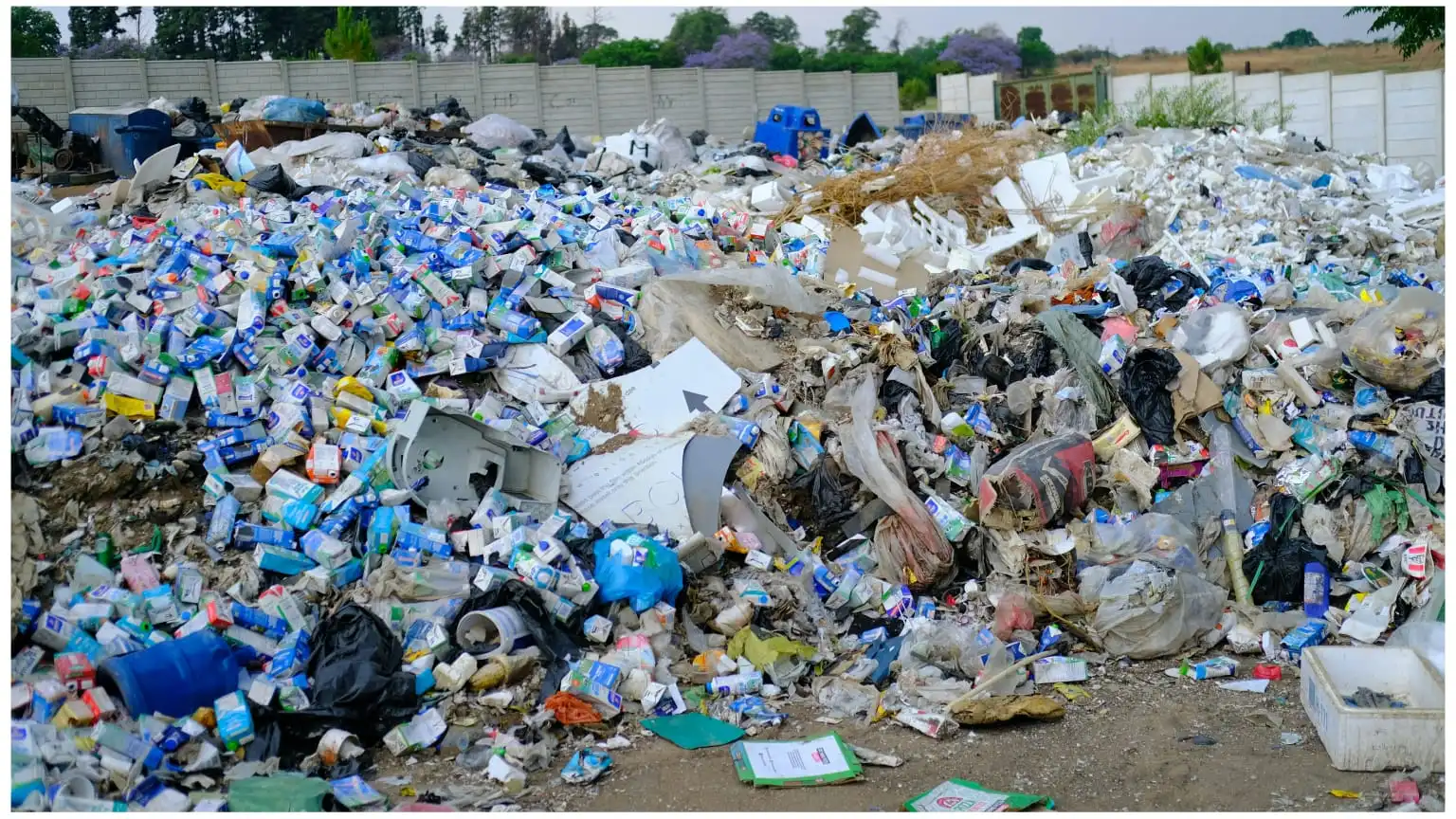
Around 3,200 to 3,500 tonnes of waste is generated every day in the DSCC area alone, and most of it goes to Matuail. Aminbazar has been reported to receive more than 3,000 tonnes a day. Figures differ by source and year, but all point the same way: far more than the sites were designed to hold.
Why the Landfills Are in Trouble
Experts say both sites are close to their limits. One report said Matuail has effectively exceeded its capacity and waste is spilling into surrounding wetlands. An analysis describes weak management: waste is not compacted and covered properly, leachate (the dirty liquid that seeps out of waste) is not treated, and gas is not captured.
Because food waste is mixed with everything else, the landfills produce large amounts of methane, a powerful greenhouse gas. One assessment estimated that Matuail alone emits about 31.54 gigagrams of methane a year. Reports from February this year also describe fires and toxic smoke at Matuail, with nearby residents complaining about the effects.
What Is Being Planned
The city corporations are now turning to new technology:
- Matuail: DSCC has signed an agreement with South Korea’s B&F Company to turn the site into a Resource Circulation Park. The plan is to make fertiliser, biogas and fuel from waste, with a pilot phase first
- Aminbazar: The Prime Minister held a meeting this year on a waste-to-energy plant by China’s CMEC Group. It aims to process about 3,000 tonnes of waste a day and produce 42.5 megawatts of electricity
The Warnings
Not everyone is convinced. Dhaka’s waste is wet and has a low heating value, which makes burning it for power difficult. An urban planner warned that there has been no pilot waste-to-energy project in Bangladesh and no research confirming that the waste is suitable. Critics argue the real fix starts earlier, with separating waste at home, reducing what is thrown away, and recycling. The government’s own manifesto points to a “Three Rs” policy of reduce, reuse and recycle, along with material recovery centres.