
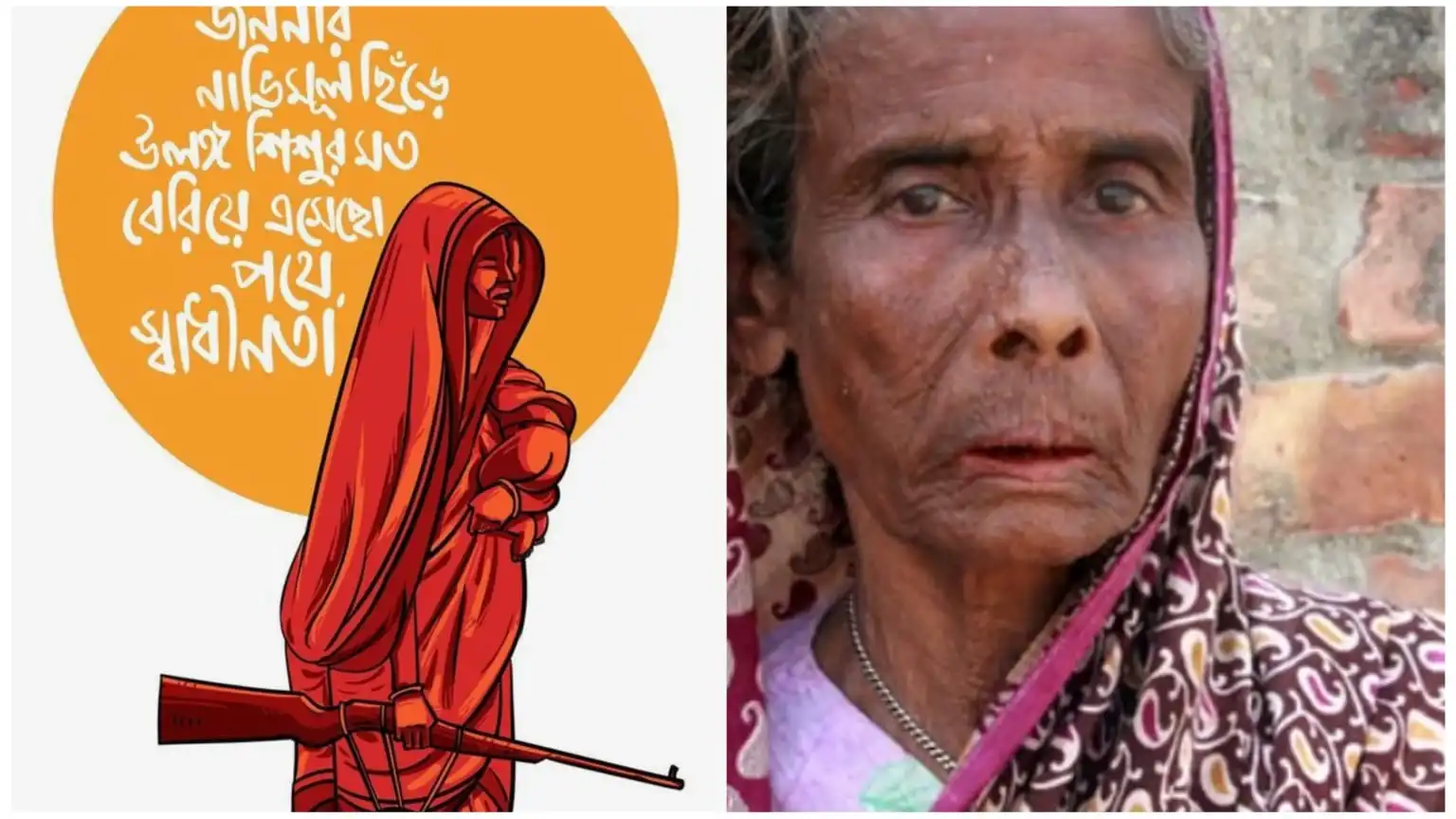
Firoza Begum was married at the age of ten. Her in-laws lived in Tarki, Madaripur, where her husband farmed and the couple lived in a house beside a wetland. Their first child was born before the Liberation War, and he was only six months old when the war began in 1971.
A Childhood Shaped by Hardship
Hardship was nothing new to Firoza. After her father was paralysed and bedridden, she helped her mother raise ducks, hens, cows and goats to pay for his treatment and to look after her younger siblings. Nothing in those years prepared her for what 1971 would bring.
The Day the Army Came
In the middle of 1971, Pakistani soldiers set fire to her home. Hearing that they were coming, Firoza tried to flee across the wetland to her maternal uncle’s house, but she could not get there and had to hide. Her baby, who had begun to walk, was still in the yard. The soldiers killed the child in front of her.
Recalling that day, she says she was about sixteen then, and that she could not bear to watch and cried out. Her grief had no time to settle. She was then subjected to brutal sexual violence. When she regained consciousness, she was blindfolded in an army camp, held with many other women, some of them elderly. She remembers weeping for days.
Rescue and Recovery
Freedom fighters of the Hemayet Bahini eventually rescued Firoza and the other captive women. After she recovered, she cooked for the freedom fighters.
Rejected by Her Own Society
Independence did not bring her peace. When Firoza returned to her village, neighbours’ talk made it impossible for her to stay, and her husband divorced her under the same social pressure. She moved to Dhaka and lived in several places, including a slum in Adabar, Shyamoli, where she worked cooking in a mess.
She later married a man named Ishaq and had a son and a daughter. Her son, Jamal, died of convulsions at just three months old. She found work as a special aide on a master roll at Shaheed Suhrawardy Hospital, while her daughter lived with Firoza’s brothers in Madaripur and studied up to class eight. Her husband then died in a road accident.
A Daughter’s Marriage, Another Heartbreak
Firoza spent all her savings on her daughter Kulsum’s wedding, including a gold chain she gave as a gift. But the marriage brought no happiness. She says her son-in-law beat her daughter, abused Firoza herself, and gave no medicine when the daughter had typhoid, then divorced her. A second marriage two years later did not last either, and neighbours kept blaming both mother and daughter.
Recognition, but Not Full Respect
State recognition as a Birangona has brought some relief. Firoza says she now receives the allowance, which supports her family. Some people respect her when they learn who she is, but others still speak ill of her or look down on her.
Her struggle is not over. She says she has found no happiness even in an independent country, and she hopes no one else is ever made to suffer as she has. In her own words, society looks down on her, even though she gave her honour so that the country could be free.