

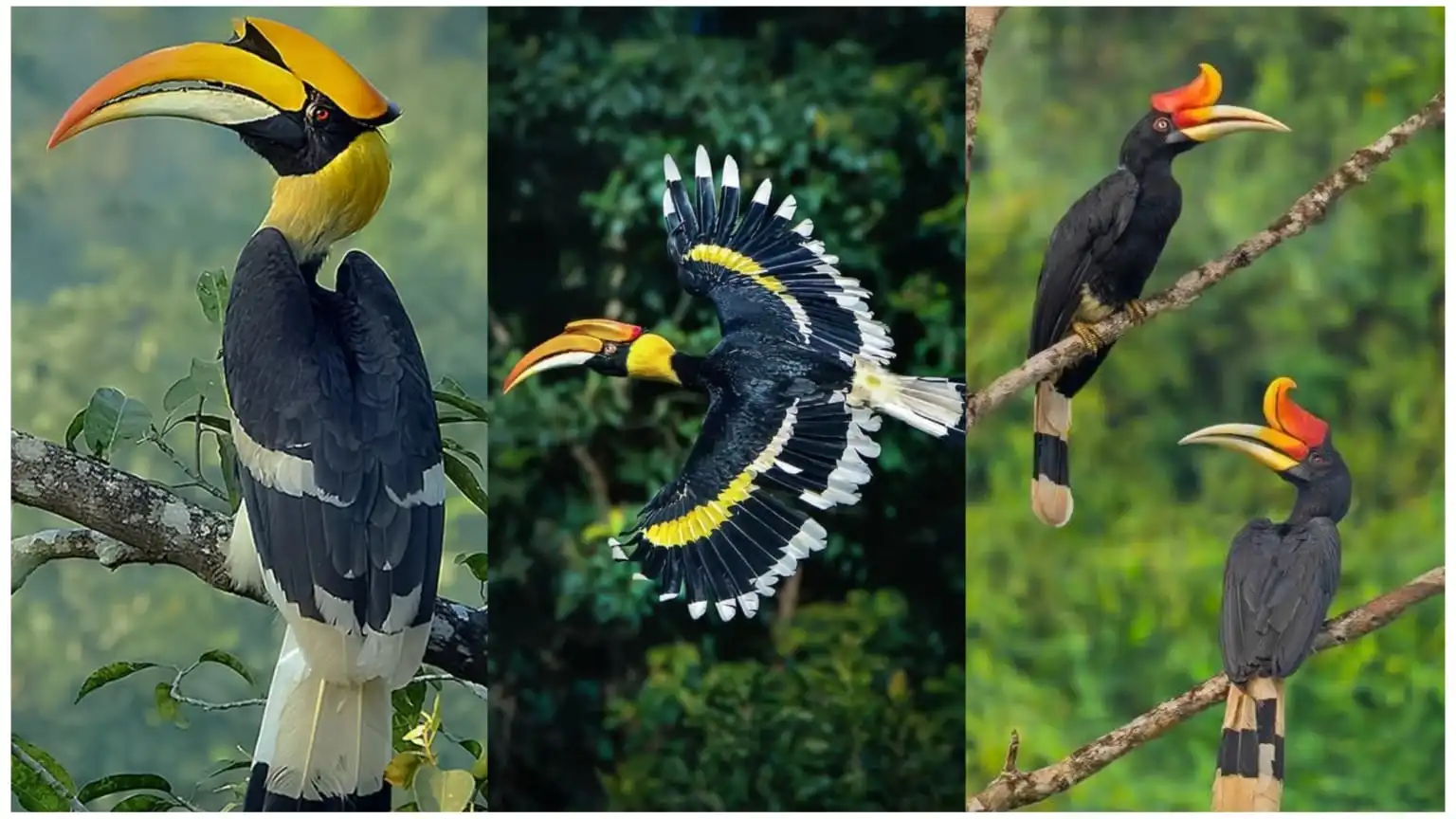
Walk through the hill forests of Bangladesh, and you might hear them before you see them. Hornbills are big, loud, and unforgettable, with huge curved bills and wings that can span around five feet. Bangladesh has several species, including the Great Hornbill, the Oriental Pied Hornbill, the Wreathed Hornbill, and the Rufous-necked Hornbill. Reference sources list three of the country’s hornbill species as threatened.
What makes them truly special is how they raise their young. A pair chooses a natural hole in a big tree, often high above the ground. The female goes inside and closes the entrance with mud, droppings, and leftover food, leaving just a narrow vertical slit. In some species, such as the Great Hornbill, the male helps by bringing mud and sealing the outside. Behind that wall, the female lays her eggs and stays with them.
Safe From Snakes, Not From People
For millions of years, this design worked beautifully. A sealed nest keeps out monkeys, snakes, and other animals that would love an easy meal. The female even sheds her flight feathers while she is inside, since she is not going anywhere. The male becomes the family’s only supplier, flying back and forth to pass fruit and insects through the slit.
The trouble is that humans do not need to squeeze through a small gap. They can climb the tree, break the wall, and take what is inside. A bird that cannot fly out in time has no escape, and the parents can only watch.
The Slow Pace of Hornbill Life
Hornbills do not bounce back quickly from losses. Even a relatively common species like the Oriental Pied Hornbill lays only a few eggs, and usually just one chick, sometimes two, survives to fledge. The whole nesting cycle can take close to three months in nearby regions. In Bangladesh, the Oriental Pied is the most widespread hornbill, yet surveys at five protected areas since 2005 show its numbers slowly falling.
There is another problem. Hornbills often come back to the same cavity year after year. That loyalty is lovely, but it also means a poacher who finds a good nest can return again and again. And because good holes are limited, hornbills must compete with parakeets, mynas, woodpeckers, and even bees for the same trees. When a big old tree is cut down, the loss can be permanent.
What Researchers Have Seen on the Ground
Conservation biologist Sayam U Chowdhury, who has traveled to remote parts of the Chittagong Hill Tracts to study Great Hornbills, describes seeing hornbill skulls in almost every indigenous village he visited. He names habitat loss, hunting, and poaching of chicks as the main threats.
In one of his expeditions, his team finally reached a nesting site only to find it empty. They believed poachers had taken the chicks and sold them at a local market for a tiny amount of money. The parent birds were circling the bare nest, screaming. It is a heartbreaking picture of how one quick act can erase a whole season of effort.
A Growing Pet Trade
Chicks are valuable on the illegal bird market, and enforcement teams have caught some of it. The Forest Department’s Wildlife Crime Control Unit has raided online bird shops and rescued hornbill chicks, known locally as Dhanesh. In June 2026, another raid on a bird trader rescued three hornbill chicks along with parrots, a hill myna, owlets, and kites.
The problem is not unique to Bangladesh. Research on Indonesia found hornbill chicks widely advertised on social media, with poachers locating nests and breaking the barrier to take the young. Raising a wild hornbill chick is difficult, and many do not survive in captivity, which means each stolen chick is often a double loss.
Vanishing Forests, Vanishing Homes
Poaching is only one part of the story. Hornbills depend on evergreen and mixed forests, and they need tall, old trees with natural hollows. Farming, illegal logging, and settlement push those forests back year after year. Without big trees, there are no nest sites, and without nest sites, there are no chicks. Fruit shortages add another strain, since hornbills also help forests by spreading seeds across wide areas.
There Is Hope
The good news is that people can make a difference. In the Philippines, a local nest-guarding program run by the group PhilinCon cut poaching of the critically endangered Rufous-headed Hornbill by 95 percent in one mountain range. Guarding known nests, working with local communities, and giving villagers a reason to protect the birds can all help.
For Bangladesh, that could mean protecting old nesting trees, strengthening patrols and online monitoring, and working with hill communities who know the forests best. Awareness matters too. Many people simply do not realize that taking one chick can end a family’s breeding season.
Final Thoughts
The hornbill’s sealed nest is a clever design that worked for ages. Today, it is a reminder of how fragile some of nature’s best ideas are when people enter the picture. If Bangladesh wants to keep hearing the roar of hornbill wings over its hills, it will need to protect both the birds and the old trees they call home.
Discover More Stories Worth Your Time
Looking for a Family Trip Before Eid?
Discover five budget-friendly weekend getaways near Dhaka for a relaxing holiday.
What Are the Top Eid Fashion Trends This Year?
Explore the latest outfit styles and fashion ideas to upgrade your Eid look.
Who Are Bangladesh’s Richest Cricketers?
See the top five stars, their estimated net worth, and successful business ventures.
Is Your Electricity Meter Overcharging You?
Learn the warning signs of a faulty meter and how to report billing issues.
How Can You Get the Tk 10 Lakh Student Loan?
Find out the eligibility, application process, and benefits of the government education loan scheme.