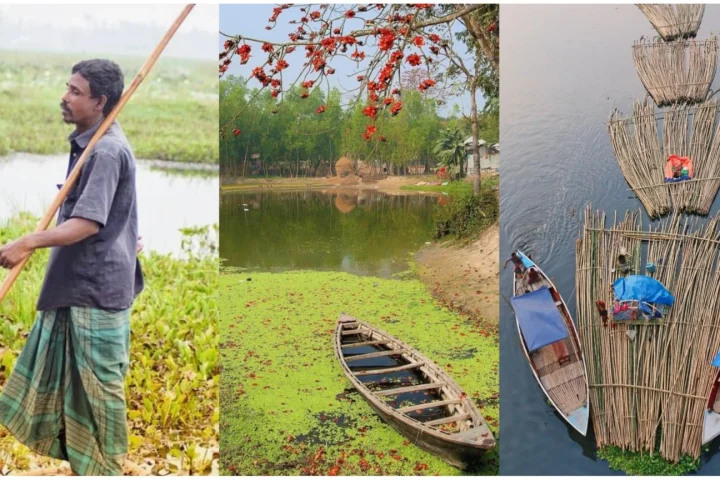

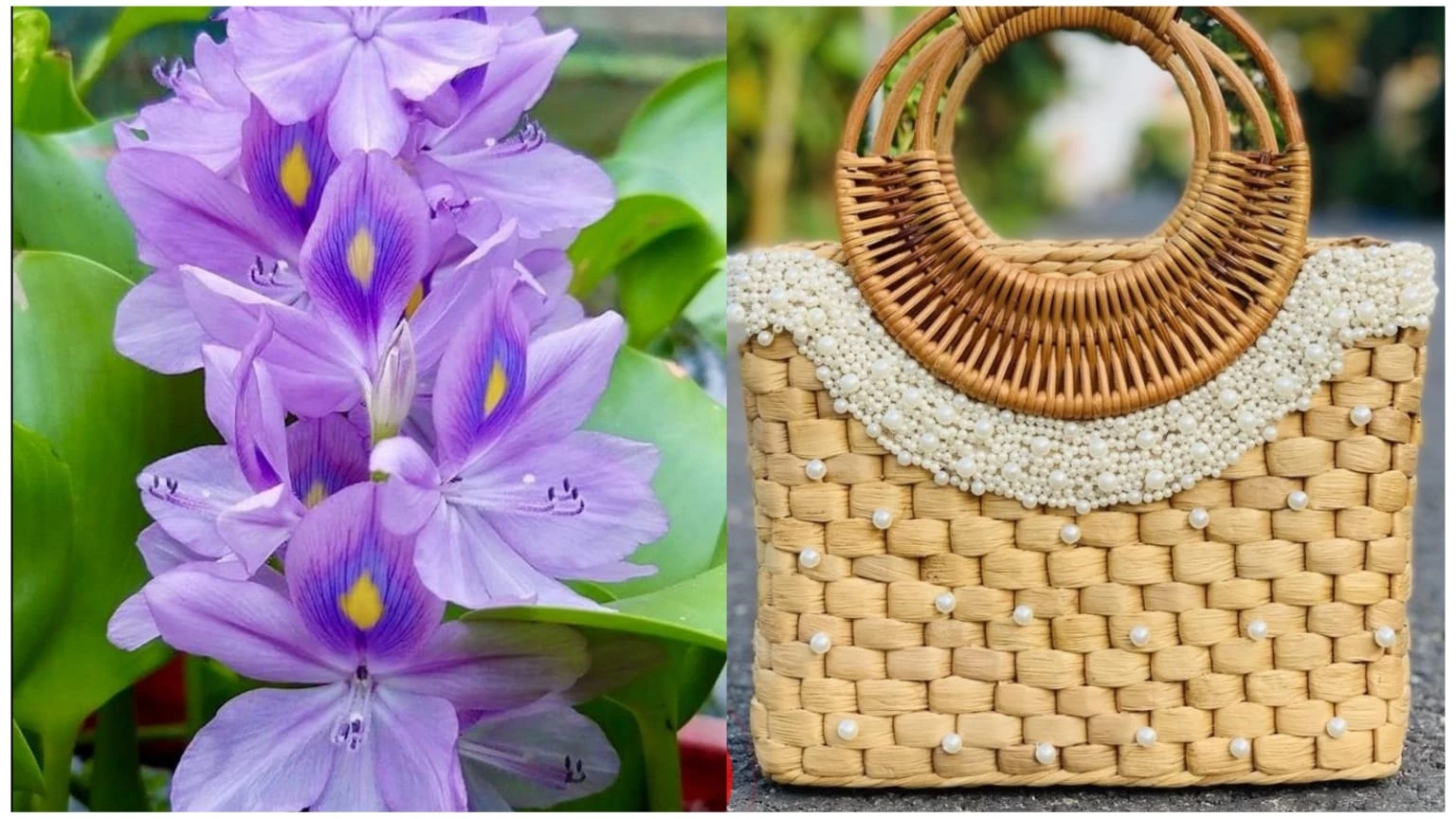
Water hyacinth is one of the most stubborn plants in Bangladesh’s waterways. It forms thick green mats that block canals needed for irrigation, slow boats, and trap water. Clearing it has long meant paying for labour, with little to show for it afterwards.
In many villages, that same plant is now seen as a free raw material. Once the stems are cut and dried in the sun, they become flexible, light, and strong enough to weave. In Jhenaidah, a news report this May described how the plant, once treated as waste to be cleared at a cost, has turned into a valuable resource.
Gaibandha: One Man’s Idea, Hundreds of Women
One of the best-known stories comes from Gaibandha. Subhash Chandra Bormon moved to his in-laws’ village in Fulchhari after living in Dhaka and noticed water hyacinth growing everywhere. He began teaching a few neighbourhood women how to weave it into home decor items such as vases, flower tubs, mats, and baskets.
The skill spread by word of mouth. According to local reports, hundreds of women in the district have learned the craft. Halima Begum, who used to be only a housewife, says she can now support her husband by working a couple of hours a day, earning around Tk 200 to Tk 300. A college student, Hasna Hena, fits vase-making around her studies and chores and earns Tk 200 to Tk 250 daily.
Exporters noticed too. A handicraft company, Eco Bangla Jute, placed an order for 30,000 water hyacinth vases for buyers in the US and Denmark, worth around worth about $3 lakh” (roughly $300,000)s in the report’s figures. Bormon said more than 300 women were working for him, earning about Tk 4,000 to Tk 8,000 per month. Schoolgirls also joined in, saying they could earn Tk 100 to Tk 150 a day, enough to buy school supplies.
Jhenaidah: Doormats, Trays, and 82 Countries
In Jhenaidah, an organisation called BD Creation supervises women who make doormats, trays, and baskets from water hyacinth, rice straw, and date palm leaves. The company says its eco-friendly products are exported to 82 countries.
The work fits around daily life. Women weave on their balconies while the plant dries in courtyards under the sun. The company buys dried water hyacinth at Tk 40 per kilogram, which means that people who simply gather and dry the plant also earn money. Khadiza Begum, whose husband is a day labourer, says her family’s situation improved over the past year after she started making water hyacinth products.
Narsingdi and Kishoreganj: A Cottage Industry
In Narsingdi and Kishoreganj, handicraft workshops have spread across villages, with hundreds of women making products from water hyacinth, hogla (seagrass), and jute. Local businessmen told a news outlet that the plant entered the market in a big way after 2020.
One factory owner pointed out that water hyacinth items are pricier to make than seagrass ones. A small item might take up to 600 grams of the plant, and workers are paid more for it. Even so, a girl named Mariam said the income lets her pay her own education costs and help her family. Some traders claimed tens of thousands of people work in the sector in a single upazila, though the reporters said they could not verify those numbers independently.
Weaving is not the only use. The women-led organisation Prokritee, which works with widows, household heads, and landless rural women, makes award-winning paper from water hyacinth. It turns that paper into journals and other items sold abroad through fair-trade retailers. The group also works with recycled saris and eco-friendly dyes, showing how one invasive plant can sit at the centre of a much wider green craft economy.
The Challenges Behind the Success
It is not all smooth. In Gaibandha, a shortage of water hyacinth in some seasons and a lack of iron frames for shaping vases kept the number of workers down at one point. Bormon has said he does not have enough capital to expand, even though demand at home and abroad is growing.
Wages can also be modest, since much of the work is done piece by piece at home. Meanwhile, buyers often prefer natural fibres that are not easy to find locally, which pushes some exporters to import materials. Experts and business owners say better training, access to credit, and support from government agencies could help the sector grow.
Final Thoughts
Water hyacinth will not disappear from Bangladesh’s waters anytime soon. But for the women drying it in their courtyards and weaving it on their verandas, it has become something far better than a nuisance. It is a steady source of income, a way to stay close to home, and proof that even the most unwanted plant can find a use when people have the skills and market to match.
Discover News With Bangla Pulse
How did Lionel Messi add another milestone to his international career?
What does the 2027 World Cup mean for Bangladesh cricket fans?
How is Bangladesh preparing to make its mark at the 2026 Asian Games?
Can Bangladesh’s women’s team make an impact against Myanmar at the Asian Games?
Take a closer look at the Bangladesh women’s team and its Asian Games clash with Myanmar.
Is Lionel Messi really nearing the end of his Argentina journey?