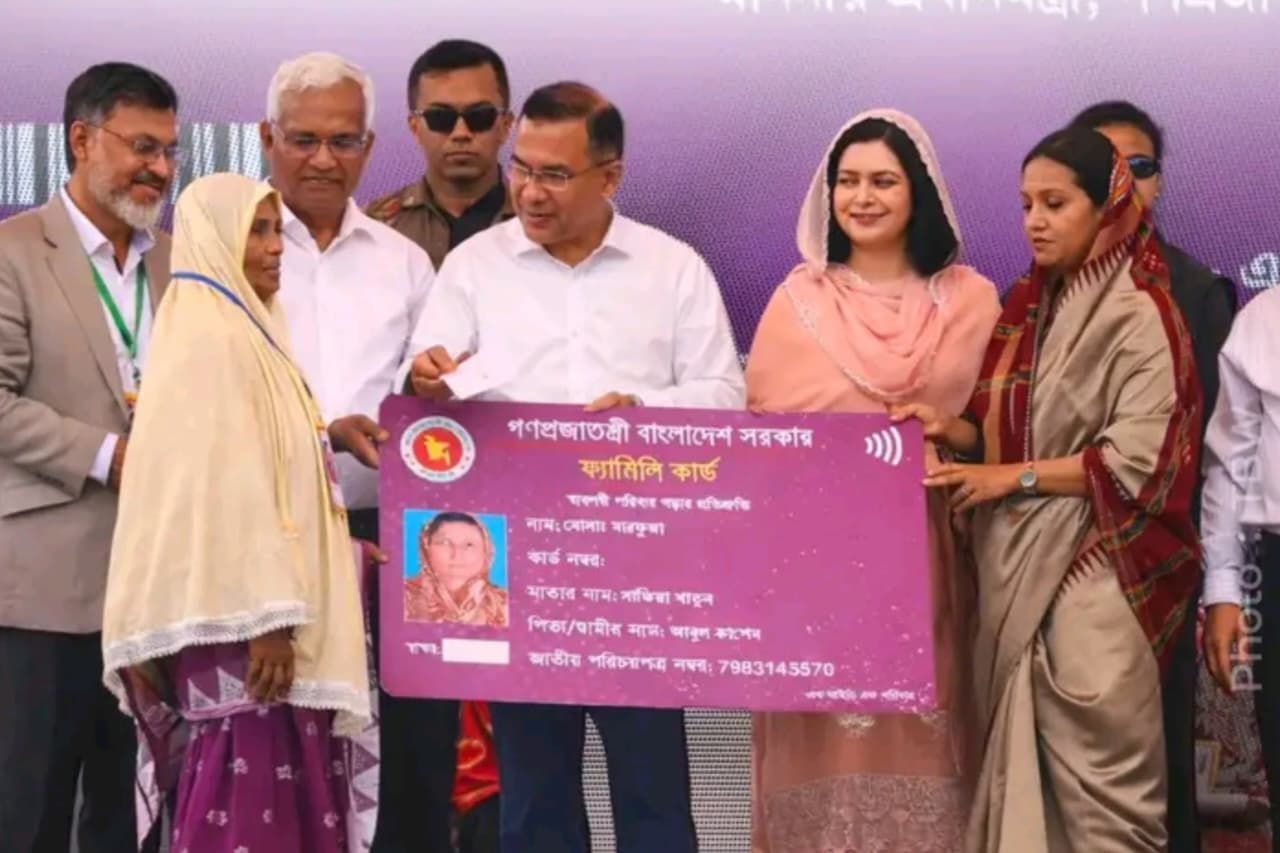
PM Tarique Rahman has revealed the “Cash Back to the People” initiative as part of a significant welfare program on April 20, 2026. The initiative was announced at a PM Tarique Rahman Family Card distribution gathering located in Bogra. The funding for this program is based on money that was taken from the people through money laundering and collected by the government during previous Administrations. This money will now be distributed back to the people, rather than being put into the general budget of the government.
This initiative represents a change towards direct benefit transfer models, which will allow for greater transparency of government funding and, in turn, ensure that government funds are received by families.
What Is the Tarique Rahman’s Family Card Scheme?
The Family Card is a program to help families who are low-income and poor. The Family Card supports low-income families living in rural areas of Bangladesh. Some highlights of the Family Card program include:
- 2,000–2,500 BDT in cash assistance every month.
- Access to additional subsidised daily necessities.
- Money can be transferred to mobile wallets and bank accounts digitally.
- Cards will primarily be issued in the name of the female head of the household.
The program began on March 10, 2026, in Dhaka and is currently being piloted in selected districts.
Discover More Stories Worth Your Time
Explore Why ODI Timing Changed?
Discover how the energy crisis forced an early start to the Bangladesh vs New Zealand series.
Check Why Fuel Prices Jumped?
Explore what caused the sudden Tk 20 spike in petrol, diesel, and octane prices.
Find Why LPG Price Fixed?
Discover what the new Tk 1,940 cylinder rate means for consumers across Bangladesh.
See Why UN Targets Iran?
Explore how the latest resolution signals a global stance against Iran’s recent actions.
Learn Will Rain Cool Heatwave?
Discover whether expected rain will ease or worsen conditions in Dhaka and Rajshahi.
Goals for Expanding the Family Card
The government has set out to expand Family Card programs to achieve the following goals:
- Nationwide pilots that target more than 37,000 households across 13 districts.
- The short-term goal of expanding Family Cards to 23 districts across Bangladesh.
- Long-term goal is to reach about 40 million families in 5 years.
Farmer Cards will also provide resources specifically to family farmers, providing an additional way to enhance rural independence.
Who Will Benefit the Most?
Some of the key priorities for this program are:
1. Women Beneficiaries
2. Low-Income Families in Rural Areas
3. Small Farmers
By issuing cards to women, the program can foster inclusion and empowerment by giving them more influence over their household purchases.
You Will Be Affected by This Programme (If you are eligible)
You will receive monthly financial assistance to assist you in purchasing food, healthcare services, & schooling
There is no complex application procedure for the beneficiaries of the program, because beneficiaries will be identified via the use of surveys
Direct transfer of funds minimises both corruption & lag time
Economic Impact on a Broader Scale
An increase in rural household expenditures will improve local economic growth
Increased access for farmers to credit through the Farmer Card program
Increased demand may drive up prices in the short term
You won’t Be Affected by This Programme (If you are not eligible)
However, you will still benefit from the growth of the economy and better rural marketplaces.
Staying current on any future phases of this program is important; it is possible that in the future phases, the eligibility requirements could be changed.
Summary
- The purpose of the PM Tarique Rahman Family Card program is to transfer recovered ill-got gains directly back to the people of Bangladesh.
- This program will provide monthly financial assistance to many families ranging from TK.2,000 to 2,500.
- The program has a strong emphasis on women’s empowerment, transparency, and rural development.
This program can potentially change the way welfare benefits are provided within Bangladesh by creating a more direct, inclusive, and impact-oriented approach.