
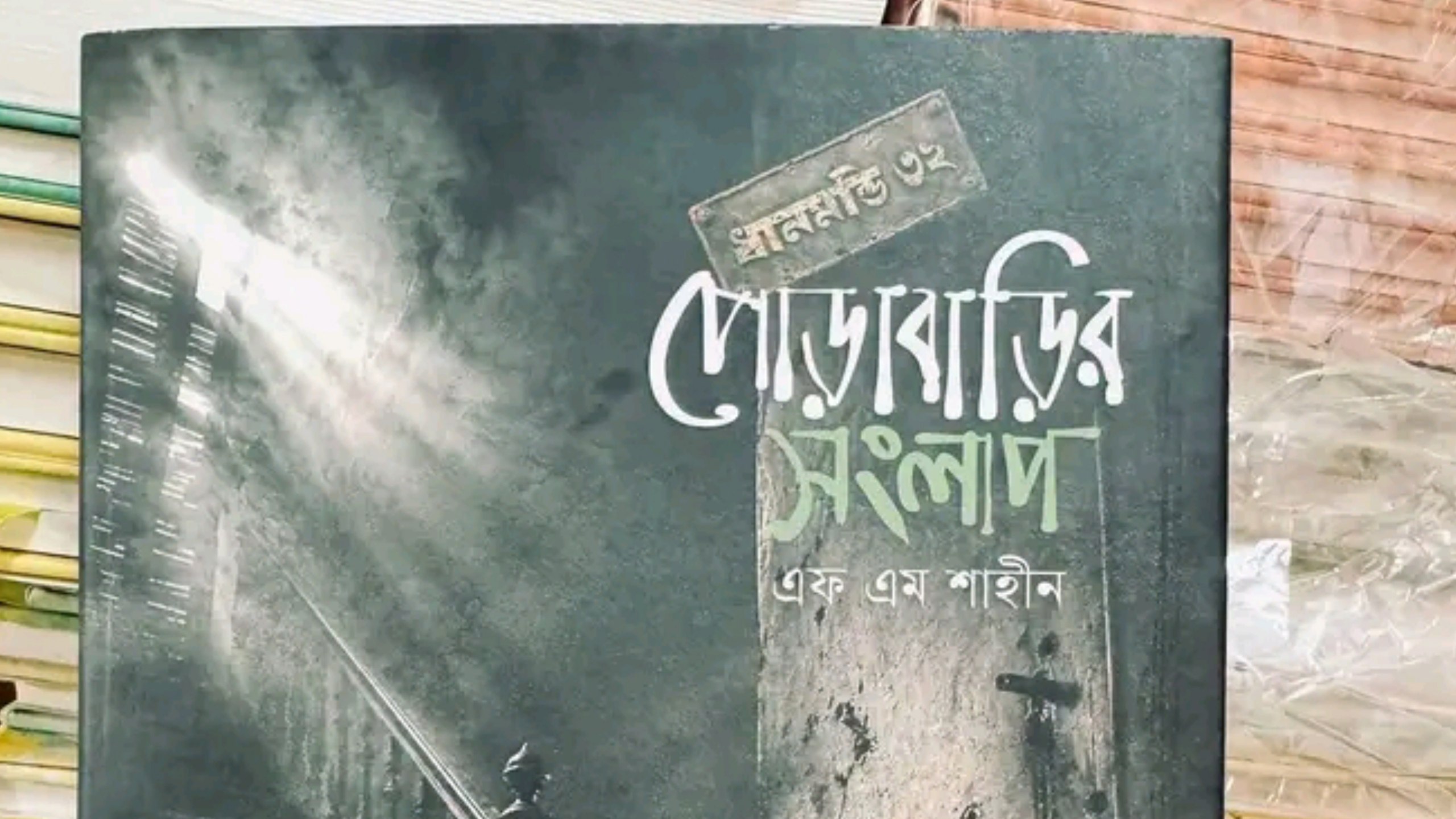
The launch took place on Sunday, August 23, at Abanindra Sabhaghar within the Rabindra Sadan premises in Kolkata. The event brought together writers, journalists, and academics from both sides of the border to discuss a question the book itself raises: can the bricks of a burnt house still speak history?
The book is published by Parampara Prakashan and takes the form of a literary dialogue built around the historical backdrop of the house at Dhanmondi 32, the residence where Bangladesh’s founding leader Sheikh Mujibur Rahman lived and was later assassinated in 1975. Shaheen uses the house as a metaphor to hold up a mirror to Bangladesh’s current political and social condition.
What The Book Explores
Rather than a straightforward historical account, the book is structured as a dialogue, weaving together memory and the present moment. Shaheen uses the residence, and its 2025 destruction by arson during the country’s political unrest, as a lens to examine questions of identity facing Bangladesh today.
At the launch, Padma Shri awardee Dr. Narayan Chakraborty praised the author’s ability to view Bangladesh’s future through the eyes of its past, calling the “dialogue of the burnt house” a living symbol of the country today. He also pointed to the central question the book poses: whether Bangladesh will define itself through a shared Bengali identity or choose another path altogether.
Concerns Over Vanishing Heritage
Senior journalist Manas Ghosh spoke at the event about his unease over the current situation in Bangladesh. Reflecting on the nature of history, he noted that it is an ongoing process shaped by ordinary people, and expressed concern that the country’s historical monuments are increasingly at risk amid political instability, citing the destruction of Dhanmondi 32 itself as an example.
Professor Ruby Sain echoed similar concerns, saying the book manages to thread together the past, present, and future, even as the present situation across the border remains deeply unsettling.
The Author’s Case for Dialogue
Despite the anxieties raised at the launch, Shaheen framed his book as an argument for conversation rather than conflict. He said human civilisation has always advanced through dialogue, and that talking through disagreements remains the only way to overcome any crisis, a philosophy reflected in the book’s title and structure.
Publisher Gautam Das said the book offers readers on both sides of the Bengal border, in India and Bangladesh, a fresh way of engaging with this shared history. The launch event also featured remarks from Bappaditya Basu, Pratim Ranjan Bose, Bijoy Dutta, and Sharabindu Saha, and closed with a musical performance by Kamalika Chakraborty.
Discover More Stories Worth Your Time
Explore What Follows Shahabuddin’s Exit?
Discover how Bangladesh’s leadership could change after the president’s departure.
Check Why Assault Case Filed?
Explore the allegations involving actress Snigdha Chowdhury and the Ashiyan chairman.
See How Microplastics Spread?
Discover why Bangladesh’s rivers, salt pans, and fish markets are raising concern.
Find Why Wetlands Face Threat?
Explore how invasive turtles are disrupting biodiversity in Dhaka’s waterways.
Learn Why Army Took Custody?
Discover the latest developments in the Brig Gen Miftah Uddin tribunal case.
Why Dhanmondi 32 Still Matters
The house at Dhanmondi 32 has long occupied a singular place in Bangladesh’s national memory. It was here that Sheikh Mujibur Rahman lived through the country’s independence movement and where, on the night of August 15, 1975, he and most of his family were killed in a military coup.
The residence was later converted into the Bangabandhu Memorial Museum. In February 2025, following the political upheaval that removed Sheikh Hasina’s government, a mob vandalised and set fire to the building, destroying much of its historical archive.
Shaheen’s book arrives at a moment when that history is being actively contested and reinterpreted in Bangladesh. By turning the ruins of Dhanmondi 32 into a literary dialogue rather than a straightforward elegy, the author invites readers to sit with the tension between memory and destruction, and to ask what remains of a nation’s founding story once its physical markers are gone. For readers across the Bengal-speaking world, the book offers less a verdict on Bangladesh’s present crisis than an invitation to keep talking through it.
Summary: A new Bengali-language book, “Dhanmondi 32, Poraobarir Songlap” (Dhanmondi 32, Dialogue of the Burnt House), was launched in Kolkata on August 23. Written by author and filmmaker F.M. Shaheen, the book uses Sheikh Mujibur Rahman’s historic Dhanmondi 32 residence as a literary device to examine present-day political and social realities in Bangladesh.