
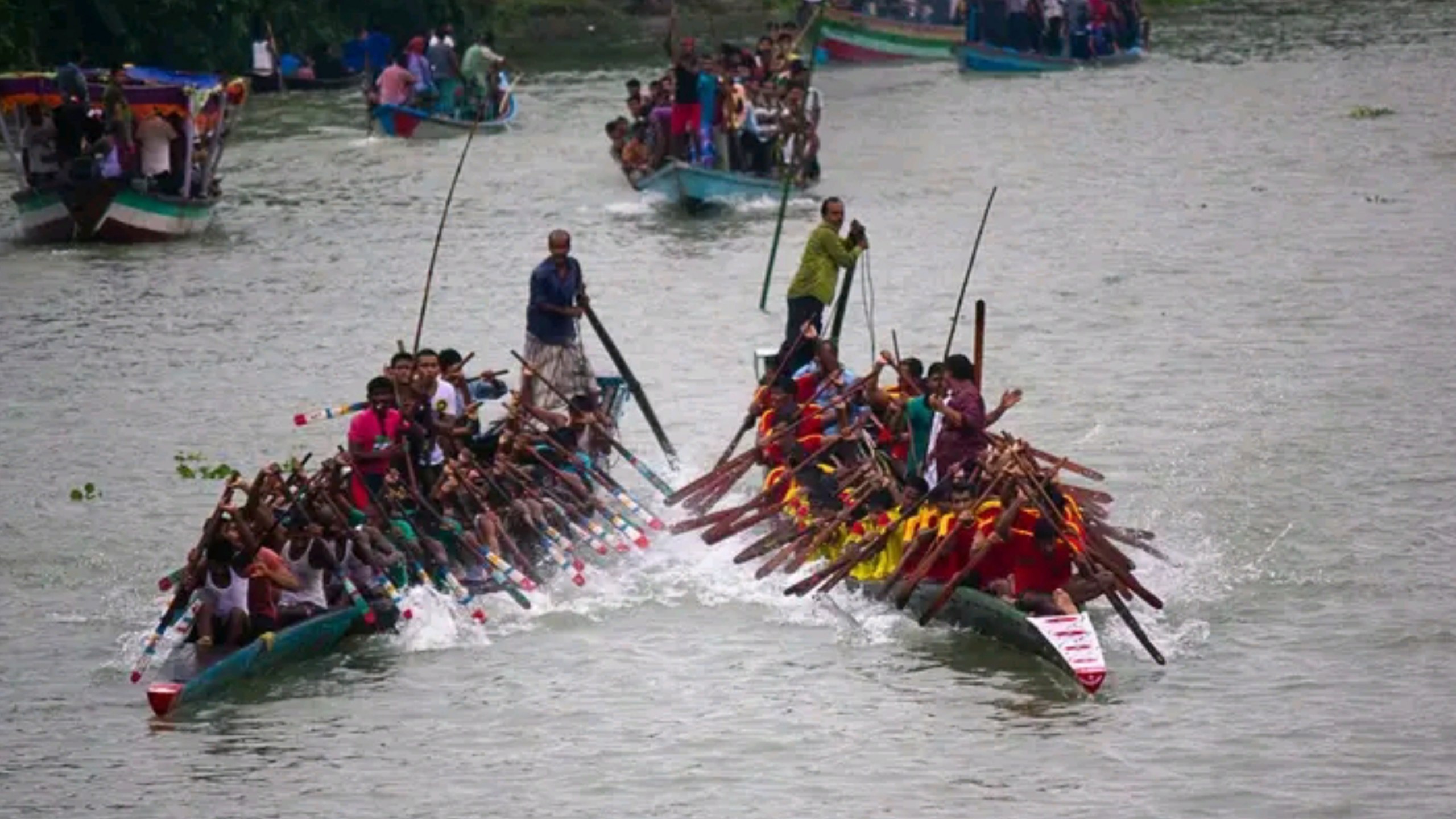
For much of the year, Kishoreganj’s haors are a patchwork of farmland and scattered villages. Once the monsoon arrives, that landscape disappears entirely underwater, turning the district into what visitors often call the Venice of Bangladesh. Nikli Haor, one of the country’s largest freshwater wetlands, becomes a vast open expanse where villages sit like floating islands and boats replace roads as the only way to get around. It is against this seasonal backdrop, roughly between June and October, that Kishoreganj’s haors come alive each year for one of rural Bengal’s most cherished traditions, the nouka baich boat race.
What Nouka Baich Actually Is
Nouka baich, literally boat race in Bengali, is a dragon-boat style paddling sport unique to Bangladesh’s riverine and wetland regions. Long, narrow racing boats, crewed by teams that can range from seven paddlers to as many as a hundred, surge across the water in tightly contested heats, powered entirely by human effort since motorised boats are barred from competition. The Bangladesh Rowing Federation, established in 1974, has overseen more than 40 national rowing championships built around this tradition, though the heart of nouka baich has always been local, organised by village youth clubs and community associations rather than any national body.
A Sport Rooted in Everyday Life
Boat races like these are not a modern invention layered onto haor culture, they grow directly out of it. Rivers and wetlands have shaped Bengal’s history, literature, and daily life for centuries, and the boatmen who compete each season are often the same men who navigate these waters for fishing, transport, and trade the rest of the year. Different districts have historically favoured different boat designs, a reflection of local craftsmanship passed down through generations of boat builders. Competing crews take pride not just in speed but in the artistry of their vessels, with boats often given bold, boastful names meant to intimidate rivals before the race even begins.
The Atmosphere on Race Day
What makes nouka baich distinctive is less the race itself than everything that surrounds it. Thousands of spectators typically gather along the banks and on smaller boats to watch, turning stretches of open water into a temporary festival ground filled with drumbeats, songs, and cheering crowds. Similar races held elsewhere in Bangladesh in recent years, including a two-day competition on the river Ghaghot in Rangpur, have drawn farmers, fishermen, students, and entire families, organised specifically to keep rural Bengal’s traditions alive for younger generations who might otherwise never see them.
Discover More Stories Worth Your Time
See Why Rising Seas Threaten Dhaka?
Discover why the UN warns millions across Mumbai, Kolkata, and Dhaka face immediate coastal risks.
Find Why Trump Praised Tarique?
Explore what the US president’s letter says about the Boeing aircraft deal.
Learn How Adani Supply Returns?
Discover how Bangladesh’s payment settlement helped restore full electricity supply from the Godda plant.
Explore Why Dengue Cases Rising?
Discover what is driving Bangladesh’s latest dengue surge and the health concerns emerging nationwide.
Why the Tradition Persists
Boat racing in the haors endures partly because it doubles as something more than sport. Local organisers frequently describe these events as a way of honouring the rivers and wetlands themselves, a rhythmic, communal expression of gratitude toward the water that shapes life in this part of Bangladesh. In a region where population density is high, and livelihoods remain closely tied to fishing and agriculture, nouka baich offers a rare seasonal pause, a moment when entire communities set aside daily routines to celebrate a shared inheritance. What began as a largely male-dominated competition has also started shifting in recent years, with more women’s crews entering local races and helping broaden who gets to take part.
A Living Piece of Bengali Heritage
Kishoreganj’s boat races are best understood as a small, deeply local expression of a tradition that stretches across the wider Bengal delta, from Bangladesh’s haors to the rural districts of West Bengal, where nouka baich follows much the same seasonal rhythm. As the water recedes each year and the haors slowly turn back into farmland, the memory of the race lingers in villages until the following monsoon, when the boats come out again, and Kishoreganj’s wetlands fill once more with the sound of drums, oars, and cheering crowds along the water’s edge.