Bangladesh is often described as a land of rivers, but it is also a land of layered history. Within a few hours of each other, you can walk through a Mughal fort, a terracotta temple, a medieval mosque city and the ruins of a monastery older than most European universities. This guide brings together ten historic places that give a real feel for the country’s past, from Dhaka to the far north and south.
Lalbagh Fort, Dhaka
Begun in 1678 by the Mughal prince Muhammad Azam Shah, Lalbagh Fort was never fully completed. Even so, its gardens, the tomb of Pari Bibi, the Diwan-i-Aam hall and the small mosque make it one of the best-loved landmarks in Old Dhaka. It is a quiet escape from the city, and a good first stop for anyone new to the capital.
Ahsan Manzil, Dhaka
Standing on the bank of the Buriganga, the pink palace of the Dhaka Nawab family was built in the nineteenth century and now serves as a museum. Its grand staircase, domed central hall and period rooms show how the city’s elite once lived. Visit in the late afternoon, when the river light turns the walls a deeper rose.
Star Mosque, Dhaka
Tucked into Armanitola, this small mosque dates from the early nineteenth century and is famous for its decoration. Its walls and domes are covered in china tile mosaic, with star motifs that give the building its name. It is compact, colourful and surprisingly peaceful, and it pairs well with a walk through the surrounding old neighbourhood.
Panam Nagar, Sonargaon
Sonargaon was a medieval capital of Bengal, and nearby Panam Nagar preserves a long street of nineteenth-century merchant houses. Many are crumbling, with faded plaster and overgrown courtyards, which only adds to the atmosphere. The folk art museum in the area is also worth a stop. Sonargaon is an easy day trip from Dhaka.
Sixty Dome Mosque, Bagerhat
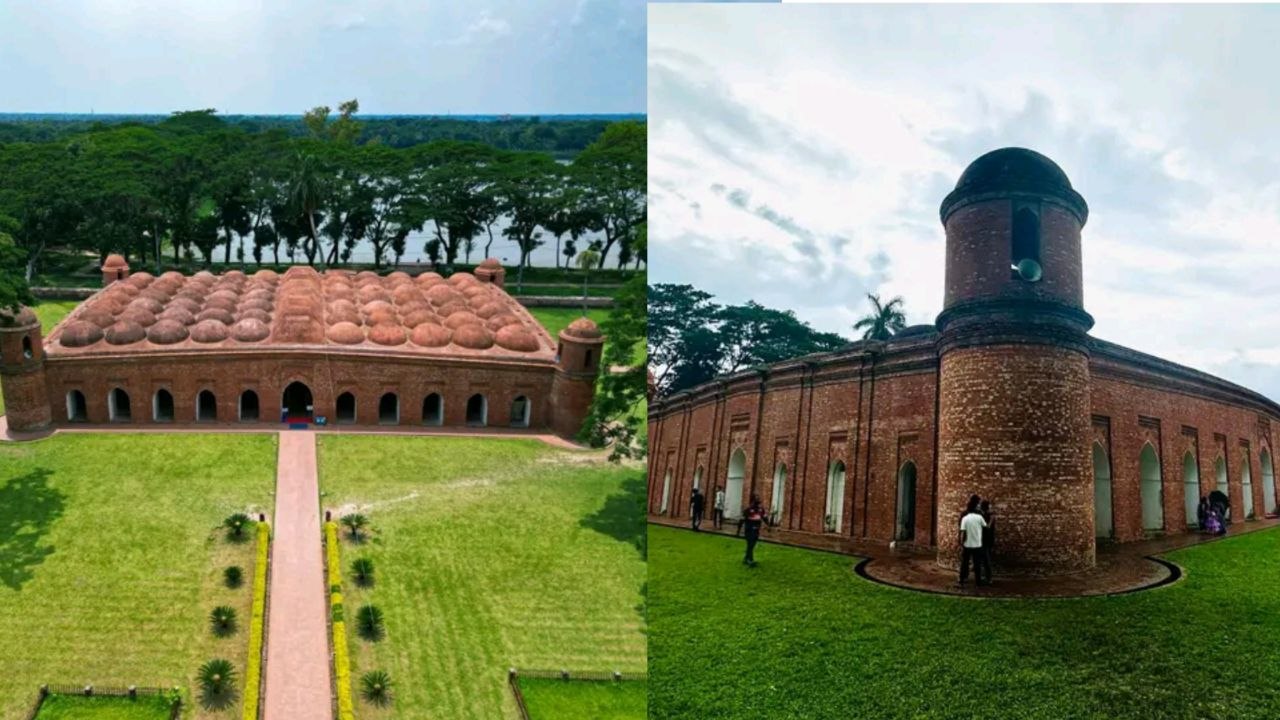
Part of the Mosque City of Bagerhat, a UNESCO World Heritage Site, this fifteenth-century mosque is linked to the saint-governor Khan Jahan Ali. Despite its name, it has far more than sixty domes, along with thick brick walls and cool, shadowy prayer halls. The nearby tombs and ponds make Bagerhat feel like a forgotten town that history left untouched.
Paharpur Buddhist Vihara, Naogaon
Also known as Somapura Mahavihara, this vast monastery was built in the late eighth century under the Pala ruler Dharmapala. It is a UNESCO World Heritage Site and is considered among the largest Buddhist monastic ruins south of the Himalayas. The central temple rises in terraces above rows of monk cells, and the terracotta plaques along its base show everyday scenes from ancient Bengal.
Mahasthangarh, Bogura
Mahasthangarh is the oldest known archaeological city site in Bangladesh, dating back to at least the third century BCE. Once the capital of Pundranagara, it still has earthen ramparts, temple mounds and a site museum. It is also a living place of faith, with a Sufi shrine and a Hindu bathing festival held beside the Karatoya River. Allow a full day.
Kantajew Temple, Dinajpur
Completed in 1722, this Hindu temple is admired for the thousands of terracotta plaques covering its walls. They depict scenes from the epics, local life, animals and flowers, making the building feel like a story carved in clay. Earthquake damage in the nineteenth century changed its original shape, but the detail that remains is still extraordinary.
Mainamati, Cumilla
Low hills near Cumilla hold the remains of Buddhist monasteries from roughly the seventh to the twelfth centuries, linked to the Deva and Chandra dynasties. Shalban Vihara and Kotila Mura are the best-known sites, and the local museum displays bronze figures, coins and terracotta objects found nearby. It is a peaceful, green site, ideal for slow exploring.
Puthia Temple Complex, Rajshahi
Puthia is a small town with a surprisingly rich group of Hindu temples built between the sixteenth and nineteenth centuries, many decorated with terracotta panels. Beside the temples stands a stately old palace and a quiet pond. Combined with a visit to Rajshahi, it makes a gentle, rewarding trip.
Discover More Stories Worth Your Time
See Which Foods Ease Seasonal Changes?
Explore five comforting foods that can help you feel your best.
Learn How To Spot H1N1?
Discover H1N1 symptoms, prevention tips, and essential facts for Bangladesh.
Explore Why Wages Stay Frozen?
Discover how stagnant minimum wages are affecting Bangladesh’s garment workers and families.
Check How Conflict Hurts Jobs?
Explore why Middle East tensions could threaten Bangladesh’s jobs and poverty gains.
Find Which Netflix Picks Worth Watching?
Discover binge-worthy Netflix choices for a relaxing weekend at home.
Tips for Planning Your Trip
The best months for visiting are November to February, when the weather is dry and pleasant. Many sites are open-air, so carry water, wear comfortable shoes and bring a hat. Dress modestly at religious sites and remove your shoes where required. Opening hours and ticket prices can change, so confirm them locally before you go. If you are short on time, group the sites by region: Dhaka and Sonargaon together, Bagerhat in the southwest, Bogura, Naogaon and Dinajpur in the north, and Cumilla in the east.
Why These Places Matter
These ten places show different chapters of Bangladesh’s story: ancient Buddhist learning, medieval Islamic building, Mughal power, Hindu temple art and the rise of Dhaka as a modern city. Visiting even a few of them changes how you see the country. Start with the one nearest to you, and let curiosity take you further.