
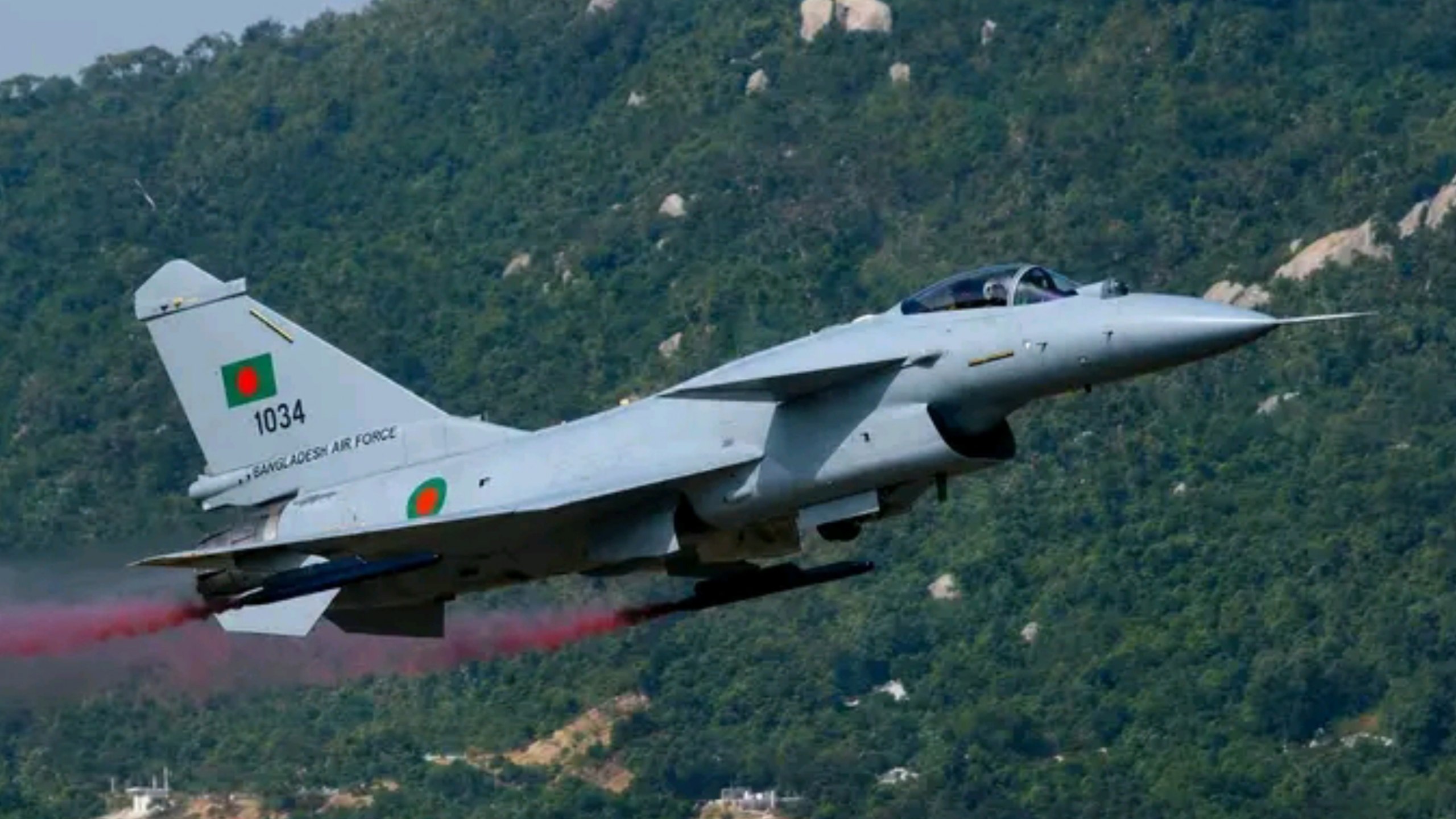
Bangladesh’s air force is on the verge of one of its most significant modernisation decisions in decades. Bangladesh is moving closer to formal negotiations with China over a possible purchase of J-10CE fighter jets and attack helicopters, with a government panel preparing a draft agreement, Prime Minister’s Information and Broadcasting Adviser Zahed Ur Rahman confirmed on Tuesday. The planned purchase would rank among Bangladesh’s biggest defence procurements in years and would deepen military ties with Beijing, which is already Dhaka’s largest arms supplier.
What’s Actually on the Table
Bangladesh is considering the purchase of up to 24 J-10CE aircraft, according to local media reports, though Rahman did not disclose the exact number of jets, the value of the deal, or a delivery timeline, saying those details would be settled through negotiations. Other reporting has filled in more specifics: one account puts the deal at 20 jets in the export configuration, with a base price of $62.7 million per unit rising to nearly $115 million once technical assistance, infrastructure development, and crew preparation are factored in. Half of the aircraft would join the Bangladesh Air Force’s active fleet, with the rest allocated to training programmes and reserves, and funding would be spread across 10 annual budget allocations running through 2036.
Separately, a Bangladeshi government committee has prepared draft documents covering two distinct acquisitions — the J-10CE fighters and attack helicopters — with the Bangladesh Air Force also pursuing broader modernisation projects including other fourth-generation combat aircraft, VIP helicopters, and unmanned aerial systems. Earlier figures reported in October 2025, when the interim government under Muhammad Yunus was advancing the file, put the package at 20 J-10CEs for roughly $2.2 billion, split between approximately $1.2 billion for the aircraft themselves and about $1 billion for training, spares, and associated support.
Notably, the attack helicopter component may not be Chinese at all. According to a report cited by Aerotime, the helicopter element appears to concern Turkish Aerospace’s T129 ATAK rather than a Chinese platform, though neither the Bangladesh Air Force nor Turkish Aerospace has publicly confirmed an order.
Why the J-10CE, and Why Now
The J-10CE has drawn global attention since Pakistan said it was used to shoot down Indian fighters during clashes between the two nuclear-armed neighbours in May 2025 — claims that remain disputed. Rahman confirmed Bangladesh had taken note of the aircraft’s reported performance during that conflict. Pakistan remains the only confirmed foreign operator of the export variant of the jet.
Cost appears to be just as decisive a factor as combat reputation. Dhaka has pointed to both lower costs and combat capability as key reasons for favouring Beijing’s jet over European alternatives such as the French Dassault Rafale, with officials noting that when India and Pakistan were at war, an Indian Rafale was reportedly downed by a Chinese J-10, and arguing that Chinese fighters are considerably cheaper than comparable European aircraft.
There’s also a fleet-replacement urgency driving the decision. The projected delivery timeline targeting 2026 and 2027 aligns with Dhaka’s pressing need to replace its obsolete F-7 aircraft before capability gaps widen further against rapidly modernising regional air forces, with the acquisition falling under Bangladesh’s broader “Forces Goal 2030” defence transformation programme.
The China Relationship Behind the Deal
This isn’t a new relationship being tested — it’s an existing one being deepened. China has supplied Bangladesh with naval vessels, combat aircraft, tanks, and missile systems over the past two decades, making it the country’s largest source of military hardware. The proposed acquisition is expected to advance around Prime Minister Tarique Rahman’s high-level visit to China, and represents one of the most consequential airpower modernisation decisions Dhaka has undertaken in years.
That said, the paper trail from the visit itself is more cautious than the deal reports suggest. The official communiqué issued after Tarique Rahman’s June 2026 visit to China referred only to plans to deepen defence cooperation through exchanges, visits, and training, without mentioning the J-10CE or any specific aircraft purchase. That gap between public diplomatic language and the more detailed reporting on deal terms is fairly typical of major defence procurements at this stage — negotiations often run well ahead of anything either government is willing to confirm on the record.
Timeline and What Comes Next
Bangladeshi officials reportedly aim to finalise or sign the agreement by August 2026, with the package valued at approximately $2.2 billion covering aircraft, training, logistics infrastructure, spares, maintenance support, and long-term sustainment. The procurements would be pursued during fiscal year 2026-27 if funding is available, or carried into the following budget cycle if not.
If the deal proceeds as outlined, Bangladesh would become the second confirmed foreign operator of the J-10CE after Pakistan. That alone gives the deal significance beyond its price tag — it would place Bangladesh’s air force alongside a small, closely watched club of J-10CE operators at a moment when the jet’s real-world combat record is still being debated following the India-Pakistan clashes.
Discover More Stories Worth Your Time
Explore Why Colombia Declared Emergency?
Discover what the powerful earthquake means for Colombia and the latest emergency response.
Check Why Jaya’s Sarees Trend?
Discover why Jaya Ahsan’s elegant saree looks continue captivating fans online.
See Where Hasina’s Crisis Leads?
Explore the accountability debate surrounding Hasina, India, and Bangladesh’s political future.
Find Which Airport Hotels Fit?
Discover convenient hotels near Dhaka Airport for short layovers and overnight stays.
The Regional Read
Predictably, a Chinese-made fighter deal on India’s eastern border hasn’t gone unnoticed in New Delhi. Reports on the deal have framed it as something that could fundamentally alter the military balance across the Bay of Bengal and India’s eastern strategic corridor, strengthening Bangladesh’s maritime security posture through improved surveillance, interception, and precision-strike capability. The negotiations also underscore China’s expanding military footprint in South Asia, where Pakistan already operates the same aircraft — meaning a Bangladeshi purchase would mark another step in Beijing’s growing defence-sector influence across the region.
For Dhaka, the calculus looks more practical than geopolitical on its face — an ageing fleet, a tight defence budget, and an existing supplier relationship that makes integration easier than switching to a new one. But in a region where every major arms deal gets read through the lens of India-China-Pakistan dynamics, Bangladesh’s next fighter jet purchase was never going to be just about hardware.
FAQ
Q: How many jets is Bangladesh planning to buy?
A: Reports vary between 20 and 24 J-10CE aircraft, with the Bangladeshi government yet to confirm an exact figure publicly.
Q: How much is the deal worth?
A: Estimates range from roughly $2.2 billion to $2.3 billion, covering the aircraft along with training, spares, infrastructure, and long-term maintenance support.
Q: Why is Bangladesh interested in the J-10CE specifically?
A: Officials have cited the jet’s reported performance during the May 2025 India-Pakistan clashes, its lower cost compared to European alternatives like the Rafale, and the need to replace Bangladesh’s ageing F-7 fighter fleet.
Q: Is the attack helicopter part of this deal also from China?
A: Not necessarily — reporting suggests the helicopter component may involve Turkish Aerospace’s T129 ATAK rather than a Chinese aircraft, though this hasn’t been officially confirmed by either side.
Q: Has China itself confirmed the deal?
A: Not explicitly. The official statement following Prime Minister Tarique Rahman’s June 2026 China visit referenced deeper defence cooperation broadly but did not mention the J-10CE or a specific purchase.