
Millions of residents in Dhaka rely on WASA, the Dhaka Water Supply and Sewerage Authority, for the water they drink, cook with, and give to their children every day. Independent research over the past several years has repeatedly found a group of industrial chemicals known as PFAS, or per- and polyfluoroalkyl substances, in that same water supply. Despite the repeated warnings, the agency responsible for the city’s water has yet to publish a testing plan or a remediation strategy, leaving residents with little clarity on what, if anything, is being done.
What PFAS Actually Is
PFAS refers to a family of more than 10,000 synthetic chemicals used in everything from textile processing and ceramics to cosmetics and industrial cleaning agents. They earned the nickname “forever chemicals” because they resist breaking down in the environment or inside the human body, building up over years of exposure. Health researchers have linked long-term PFAS exposure to elevated risks of certain cancers, immune system damage, thyroid disease, and hormonal disruption.
Bangladesh is a signatory to the Stockholm Convention on Persistent Organic Pollutants, which bans several PFAS compounds outright and places others under international review, yet enforcement inside the country has lagged far behind the scale of industrial chemical use.
A Pattern Of Warnings Going Back Years
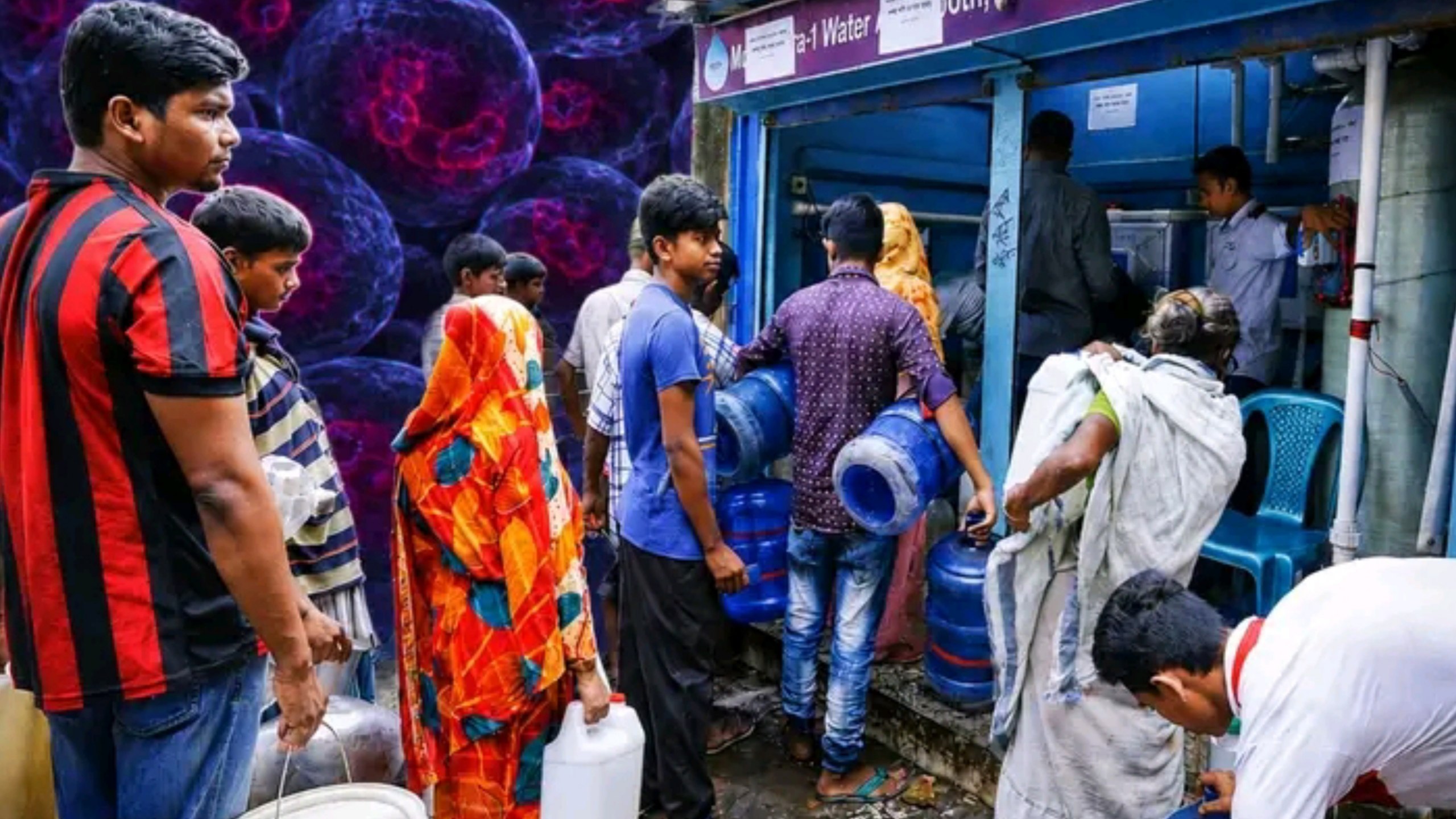
The concern is not new. A 2020 situation report produced by the Environment and Social Development Organisation in partnership with Brown University found PFAS compounds, including perfluorooctanoic acid and perfluorooctane sulfonic acid, in both surface water and tap water across Dhaka. A follow-up study in 2024, conducted jointly by Sher-e-Bangla Agricultural University and Sweden’s Umeå University, again detected PFAS in water sold through Wasa’s network of water ATM booths, which serve more than 800,000 customers and dispense roughly 1.3 million litres a day.
Separate testing near Dhaka’s textile factories, a sector that accounts for roughly half of all global PFAS use, found chemical levels in some samples far exceeding regulatory limits set in the European Union and the United States. Several samples reportedly contained compounds already banned under international agreements.
WASA’s Response Has Been Slow
After the most recent round of findings drew public attention earlier this year, Wasa’s board chairman said the agency would form a five-member committee, made up of Wasa officials and researchers from Sher-e-Bangla University, to determine a course of action. More than eight months later, environmental groups say that committee has not published any findings or announced a concrete remediation plan.
Shahriar Hossain, secretary general of the Environment and Social Development Organisation, said the contamination problem extends beyond drinking water alone, since PFAS from industrial discharge and uncontrolled chemical use is also entering the food chain. He argued the issue needs to be addressed immediately, warning that continued contamination poses a serious risk to both human health and the surrounding ecosystem.
Some Wasa officials have pushed back on the severity of the findings. A former deputy managing director has previously maintained that the agency’s water is entirely free of organic chemicals, bacteria, and metals, a claim that sits uneasily alongside the independent lab results that keep surfacing.
Discover More Stories Worth Your Time
Explore Why Colombia Declared Emergency?
Discover what the powerful earthquake means for Colombia and the latest emergency response.
Check Why Jaya’s Sarees Trend?
Discover why Jaya Ahsan’s elegant saree looks continue captivating fans online.
See Where Hasina’s Crisis Leads?
Explore the accountability debate surrounding Hasina, India, and Bangladesh’s political future.
Find Which Airport Hotels Fit?
Discover convenient hotels near Dhaka Airport for short layovers and overnight stays.
Why Standard Treatment Falls Short
Part of the problem is technical. Chlorination, the primary method Wasa uses to disinfect water, kills bacteria but does nothing to remove PFAS or other persistent organic chemicals. Environmental scientists say more advanced treatment, such as ion exchange filtration, would be needed to strip these compounds from the water supply, and that approach comes with a significantly higher cost than the chlorination-based system currently in place.
Groundwater sources, which supply the majority of Dhaka’s water, are also vulnerable to contamination through leaks in ageing supply and sewerage lines, as well as runoff near waste disposal sites, adding another pathway for chemicals to reach the taps of ordinary households.
What Residents Are Left With
Bangladesh has committed under the UN Sustainable Development Goals to universal access to safe drinking water by 2030, and the World Health Organisation has urged member states to monitor PFAS levels and take preventive action. For Dhaka’s residents, that commitment currently exists mostly on paper. Without public test results, a published treatment timeline, or independent oversight of Wasa’s internal review, the city’s water safety concerns are likely to keep resurfacing exactly as they have for the past several years, one investigative report at a time.