
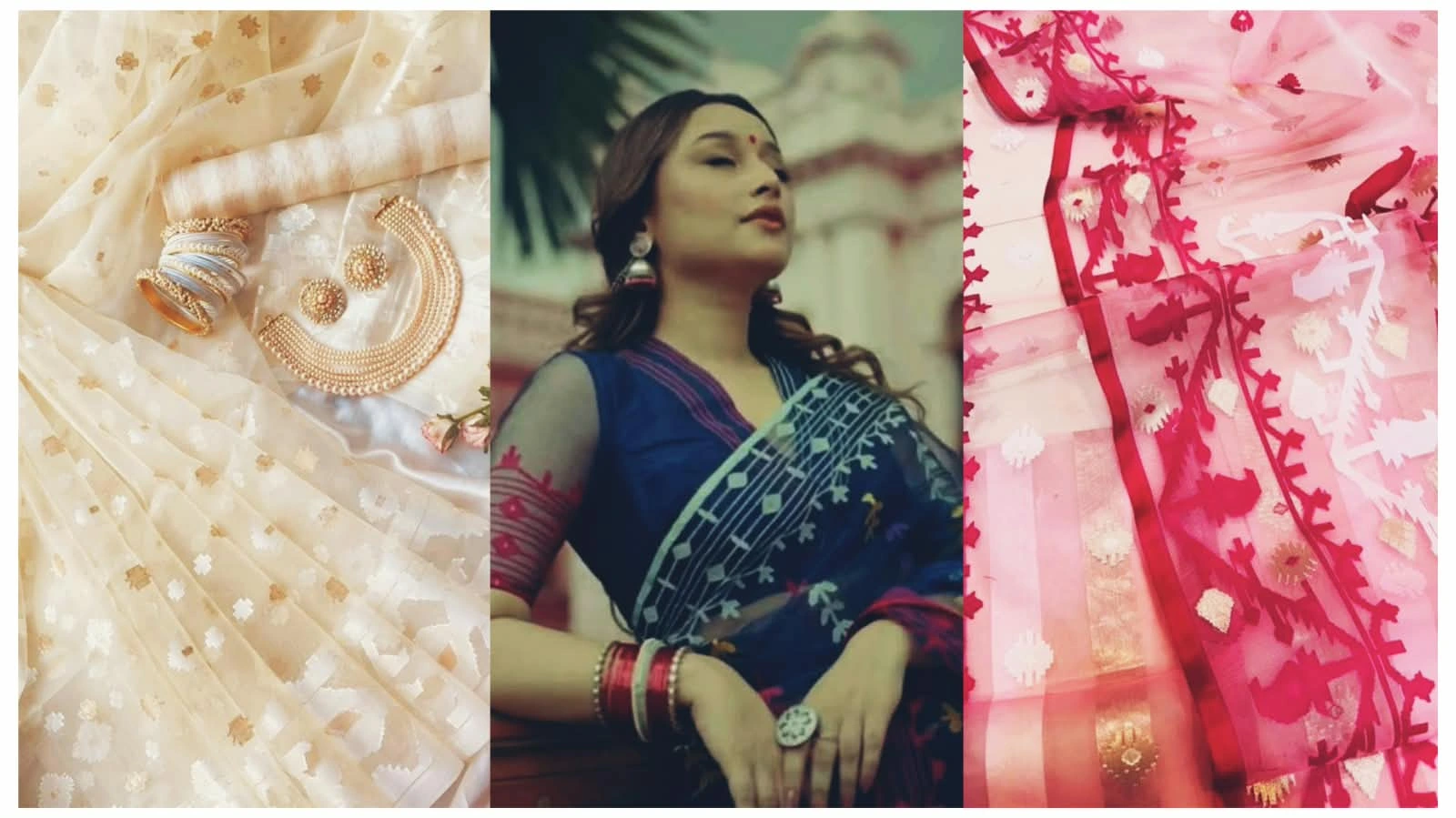
Look closely at a Jamdani sari and you will see tiny flowers, leaves and diamonds floating on a sheer, airy base. These patterns are not printed or embroidered. They are woven into the cloth, and their names tell you what they look like or where they sit.
Woven on the Loom, Not Drawn on Cloth
Jamdani motifs are created while the fabric is being woven. A weaver follows a design map or a pattern held in memory. Each motif is added by hand, using a separate extra weft thread, which is a thread that runs across the cloth. The thicker pattern yarn passes between selected warp threads, so the design sits slightly raised above the fine ground cloth.
Because the pattern thread appears only where the design needs it, this method is called discontinuous weft weaving. A master weaver usually plans where motifs will go first, often across the body, the border (paar) and the end panel (anchal).
How Jamdani Motifs Get Their Names
Most names are Bengali craft words based on what a motif resembles. Weavers have named designs after flowers, leaves, fruit, coins, sweets and animals. Others are named for their layout, such as scattered, diagonal or all over. A small repeated flower is a buti, a full net of motifs is a jaal, and a diagonal arrangement is a tersa.
1. Wondering which traditional Bangladeshi dishes are slowly disappearing from our kitchens?
Take a delicious trip into the past with these lost recipes and forgotten traditional dishes of Bangladesh.
2. Love Ilish but want to move beyond the usual preparation?
These classic Ilish recipes bring some of Bangladesh’s favourite fish dishes to your kitchen.
3. Think you know Bangladeshi cuisine? You may be missing these hidden gems.
Discover lesser-known Bangladeshi dishes that deserve a place on every food lover’s list.
4. Looking for something warm, comforting and seasonal when the monsoon arrives?
Try these healthy monsoon comfort food recipes inspired by homestyle flavours.
5. Weekend plans but no idea what to cook? Why not make biryani?
From familiar favourites to exciting variations, here are 7 biryani recipes to try this weekend.
Common Jamdani Motifs and Their Meanings
| Motif Name | Meaning or Design Feature |
|---|---|
| Butidar | Small flowers or sprigs scattered across the body |
| Panna Hajar | “A thousand emeralds,” a prized floral design linked with gold or silver thread accents |
| Kalka (Kolka) | Paisley or mango shaped motif |
| Tersa (Tercha) | Motifs set in a diagonal or slanting arrangement |
| Jalar (Jaal) | Motifs spread evenly over the whole fabric |
| Duria | Polka dot pattern |
| Charkona | Rectangular or four cornered motifs |
| Fulwar | Flowers arranged in straight rows |
| Kalmilata | Lime like fruit motif |
| Kachupata | Leaf motif |
| Ashrafi | Motif inspired by a gold coin |
| Sandesh Pad | Motif inspired by the Bengali sweet sandesh |
| Bagher Paa | Tiger’s paw motif |
Why This Design Vocabulary Matters
Jamdani designs are also described by position. Buti means scattered small motifs, paar is the border, anchal is the decorated end piece and jaal is an all over pattern. This shared language lets weavers, traders and buyers talk about a sari’s style clearly, even though motifs differ a little from one loom to another.
What Is a Jamdani Motif?
It is a pattern woven into Jamdani cloth by hand, using an extra thread that forms the design on the fabric.
Are Jamdani Motifs Printed or Embroidered?
No. They are woven into the sari on the loom as the cloth is made, not added afterwards.
What Does Panna Hajar Mean?
It means “a thousand emeralds.” It is a much admired floral design, traditionally linked with gold or silver thread.
What Is the Difference Between Buti and Jaal?
A buti is a small, scattered motif such as a tiny flower. A jaal is a net of motifs that covers the whole cloth.
Where Do Motifs Appear on a Jamdani Sari?
Most often on the body, the border (paar) and the end panel (anchal).
Why Are Jamdani Motifs Named After Everyday Things?
Weavers named designs after what they resemble, such as leaves, fruit, coins, sweets and animals. That made the names easy to remember and share.