A Nation’s Call to be Heard: Before 1971’s independence from Pakistan, East Pakistan (which today is called Bangladesh) was a neglected area that was rich in language, culture and national identity. The people of East Pakistan spoke Bengali, had their own traditions, and increasingly sought autonomy from what many perceived to be an oppressive regime.
A number of issues had been festering between East and West Pakistan for many years prior to the elections, which took place on December 7th 1970, where the people of East Pakistan had an opportunity to express their options through the democratic process. Election results were favourable to East Pakistanis; however, once again due to the West’s dominance, the East was denied administrative power of its own government after this election and instead of remedying the deep-rooted political frustration, it began a series of events which resulted in the development of a tragedy of unprecedented dimensions throughout this area of South Asia.
On March 25, 1971, the Pakistan military’s operation
The task provided substantially greater levels of terror, violence, and destruction than anyone could have ever anticipated. Beginning in Dhaka, the Pakistan military’s operation expanded throughout the entire area of East Pakistan (which is today Bangladesh).
Those who experienced the events of that night were acting under orders of an organised agenda, not randomly or through chaos. In addition, the military utilised soldiers that possessed a list of their intended targets (political leaders, students, professors, journalists and ordinary citizens), therefore delivering death to residents of all ages and categories throughout this area of East Pakistan through mass murders.
At Dhaka University, students in their dorms were murdered by gunfire. After military forces killed students, they set entire buildings ablaze, and when women attempted to escape the flames, they were shot by Pakistani troops as they fled.
What Do We Mean by “Genocide”?
Genocide can mean something powerful, but it is also legally defined under international law. Genocide will include acts such as killing someone, causing them severe harm, or intentionally destroying an entire group through acts that cause destruction to that group with the intention of fully or partially eliminating that group.
Genocide can be committed against groups defined by their nationality, ethnicity, race, or religion. When we take the above definition and apply it to 1971, we see that the question of whether or not the Bengalis are being targeted as a national group or Hindus are being targeted as a religious group has become very clear. The historical record, eyewitness accounts, and subsequent investigations give us a great deal of evidence to conclude conclusively that these groups were indeed targeted.
When Identity Became a Target
The violence of 1971 followed a specific pattern; it was not only control but also identity.
Attacks on the Bengali People
The purpose of attacking and breaking down Bengali society was to eliminate the Bengali people from existence; therefore, the Bengalis would be unable to form organisations or to develop, think or re-establish the community itself after destruction.
Targets on Hindus
Hindus, more specifically, faced some of the worst persecution during that time; their homes were marked, temples were destroyed, and many entire communities of Hindus were burned down. Many were forced to flee or ended up as refugees simply because of their religion.
Targeting people based solely on who they are is what defines genocide above all else.
Violence Beyond the Battlefield
The events of 1971 could not be described as the “normal tragedy of war.”
Women were subjected to organised sexual violence through the systematic use of rape, not arbitrary but intentional, to create fear and destroy communities from the inside out.
The nighttime imposition of curfews was not intended to provide safety but to provide cover for raids. Villages were destroyed through arson, and civilian populations were attacked with no resistance in place.
Millions fled to India seeking refuge from death, violence, and starvation.
These were not improvised or accidental acts of war; they were calculated acts of war.
As violence increased, so did the humanitarian crisis, as millions of refugees flooded into India and overwhelmed the bordering states.
Initially, India provided humanitarian assistance in the form of shelter, food, and other assistance. However, as time progressed and conditions worsened, India began to provide assistance to the resistance group called the Mukti Bahini.
By December 1971, India formally entered the war, and the military campaign to defeat the Pakistanis was completed rapidly.
A Nation is Born, But the Wounds Remain
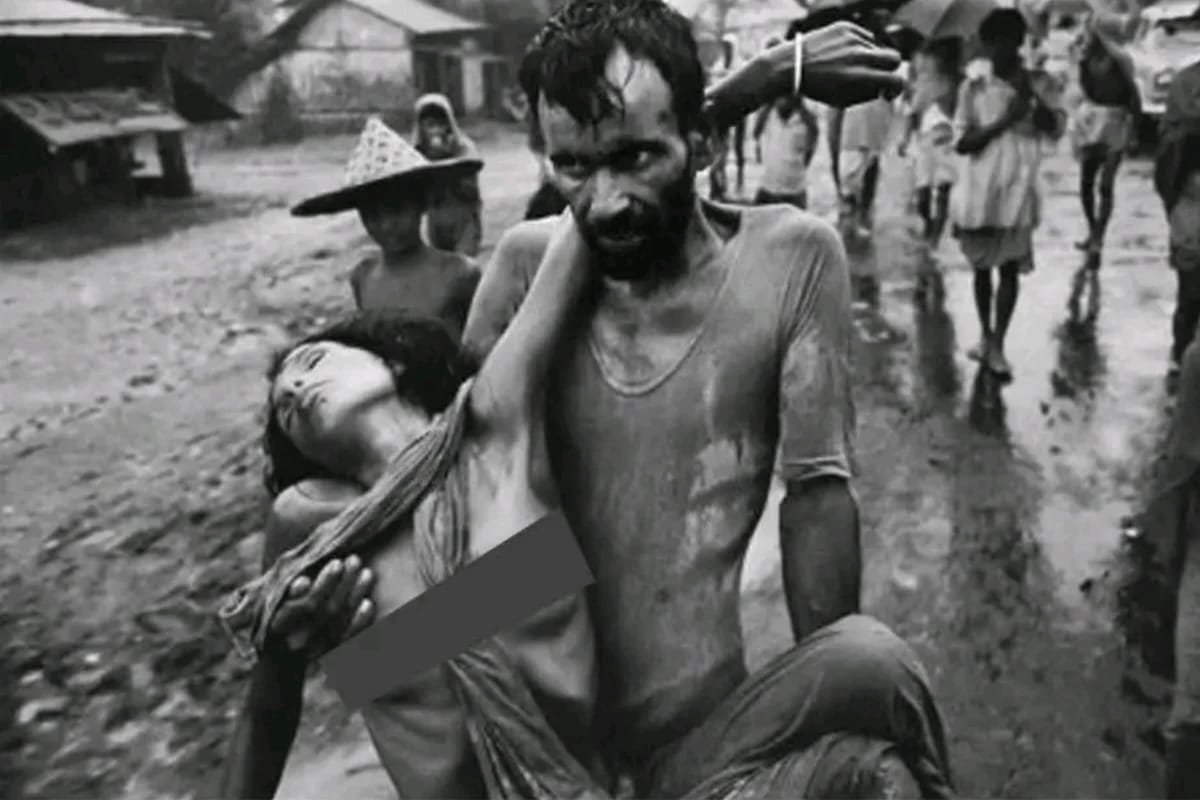
The price of freedom was horrifying: About 3 million people were killed, and more than 200,000 women were raped. Many families lost their homes and their loved ones.
The trauma of the people who suffered did not end when they were free to live again. They lived with the memories of what had happened for many years after independence. Many stories remained untold, especially those of the women and minorities.
How Do We Prove the Truth?
The events that occurred in 1971 are not just based on human memory but are supported by credible evidence.
There are many examples of US Official Diplomatic Cables, Eyewitness reports and Facts from around the world that describe a “Reign of Terror”. Also, there are some examples of “Selectively Targeted Genocides” supported by these Diplomatic Cables, Eyewitness reports and Worldwide Facts.
There have been documented reports from around the world describing how Hindu areas were specifically targeted, with lists kept of people for targeting.
In subsequent years, there were several Pakistani government investigations that conclusively documented that these operations were exemplified by using alarming pre-planning and coordination of execution.
When independent corroborating evidence from Survivors, Field Report and other Official Documentation is collected and compared, there is no longer any doubt about the truth of these events.
But Wasn’t It Just a Civil War?
This question comes up a lot, but it is very misleading.
There was fighting later in 1971, when Pakistan invaded India in December; this was to a great extent a conflict between the militaries.
But the majority of these incidents were not warfare – they were acts of violence against innocent civilians.
There was house-to-house killing, targeting students, burning of temples, and mass sexual violence towards children; they were not done as a part of a large battle but, rather, for spite or terror based on their identity (caste group/religion/origin) rather than anything they did.
Why Wasn’t the Genocide of 1971 Officially Recognised by the United Nations (UN)?
Although there is more than ample evidence of the genocide of 1971, the genocide that occurred in 1971 has not yet been recognised by the UN as a genocide.
The UN has recognised other genocides that have occurred, including the Holocaust, Rwanda, and Bosnia, and it was created to promote human rights and to stop events like this from occurring.
So why was Bangladesh different? There are many reasons given by various experts as to why:
1) Political sensitivities and international diplomacy
2) There are formal procedures that need to be followed, and a consensus reached on the issue
3) There hasn’t been long-term or sustained global advocacy over time for the issue
While the UN has acknowledged the level of violence that occurred and the humanitarian catastrophe of 1971, there are multiple reports and discussion references within the UN regarding the large-scale killing, genocide, and other human rights violations; there has never been a UN Resolution that uses the term “genocide”.
The evidence is clear and overwhelmingly supports the case for the genocide of the people of East Pakistan/Bangladesh.
Discover More Stories Worth Your Time
See Why Tollywood Costs Rising?
Check how stricter safety regulations are reshaping production budgets after the recent tragedy.
Find Cheapest Study Abroad Options?
Discover the most budget-friendly countries for Bangladeshi students planning higher studies in 2026.
Explore Can Zeera Help Thyroid?
Discover how this simple detox habit may support cholesterol balance and daily wellness naturally.
Check How DU Admission Works?
Explore the step-by-step undergraduate admission process for Dhaka University applicants this year.
Learn How Cyclones Became Safer?
Discover how Bangladesh’s early warning systems drastically reduced cyclone-related deaths over time.
Why Recognition Matters Today
Some might wonder why it’s important to recognise the past so many years later. It’s important because recognition doesn’t only have relevance in terms of what happened and how we understand what has happened, but also; it has an impact on our response to current and future events.
When genocides are not defined as genocide on a global level, global awareness for taking actions to prevent future genocides from happening is diminished. It indicates to many people that there are many historical events that have taken place and will continue to take place that could go unrecognised. By providing recognition of the victims of genocides, we provide a degree of dignity to the victims and validate the experiences of those who survived. Recognition also reinforces our collective commitment to ‘never again’ allow such atrocities to happen again.
Transforming Memory into Responsibility
The events that occurred in 1971 are not only Bangladesh’s history—they are a teaching moment for a global audience.
Even today, throughout various parts of the globe, various groups of people continue to see persecution of minority groups during conflicts around the world. The methods of persecution are often very similar: targeting the identity of victims, silencing victims who can directly speak to their experience of genocide, and not allowing the truth to be spoken.
The 1971 genocide is not about reopening old wounds. The remembrance of the events of 1971 must focus on preventing a similar type of event as well as preventing similar events from happening again.
The Need to Remember, The Need to Do
Over 50 years later, Bangladesh is now an independent country. However, its evolution from independence to complete recognition of its history is ongoing.
To recognise the genocide of 1971, we must not view this only as a political act; it is also a moral act.
Historically speaking, if there is no definition of an event in history being acknowledged, then that part of history is at risk of being lost.
If an event in history is lost, it is at risk of happening again.