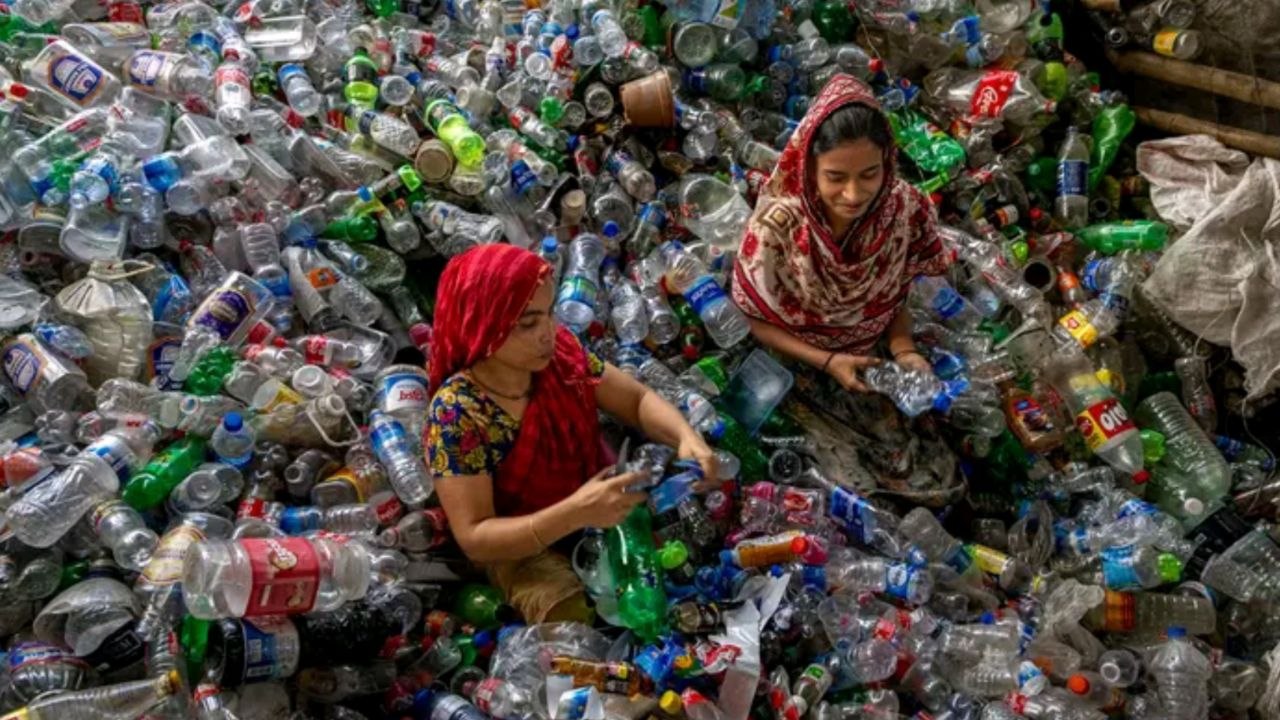
Dhaka’s relationship with plastic has quietly become one of the city’s defining environmental problems. A 2020 World Bank report found that only 37% of the plastic waste generated in Dhaka gets recycled, and almost all of that recycling happens through the informal sector, clustered in neighborhoods like Islambagh in Old Dhaka, rather than through any organized municipal system. The other 63% doesn’t just disappear. It piles up in landfills, clogs drains, or ends up in the city’s rivers.
How Much Plastic We’re Actually Talking About
The scale of the problem has grown fast. Bangladesh generates around 3,000 tonnes of plastic waste every day nationally, according to a 2022 study by the Environment and Social Development Organisation, and experts say production has only increased since. In Dhaka specifically, daily plastic waste rose from 178 tonnes in 2005 to roughly 646 tonnes in 2020, according to World Bank figures, a more than threefold jump in just 15 years.
Per-person consumption tells a similarly steep story. Dhaka’s annual per capita plastic use stands at 22.25kg, more than three times the national average for metropolitan areas in Bangladesh. Single-use items are a huge part of this, close to 1.4 million polythene bags are discarded in Dhaka every single day, with the average Dhaka household going through about five bags daily.
Where All That Plastic Actually Goes
Once you look past the headline 37% recycling figure, the breakdown of where the rest of Dhaka’s plastic ends up is where the real problem shows itself. According to World Bank data cited in a government action plan, 48% of plastic waste goes to landfills, 37% gets recycled, 12% ends up in water bodies, and the remaining 3% is dumped in drains or unserved areas. None of Dhaka’s landfills are engineered or lined, meaning plastic and other waste sitting in them leaches contamination directly into surrounding soil, rivers, and groundwater over time.
The Buriganga River, long considered Dhaka’s lifeline, has become one of the most visible casualties. What used to be a thriving waterway has, over roughly half a century since single-use plastic use began in Bangladesh in the 1980s, become choked with plastic waste, a slow accumulation that’s now hard to miss along its banks.
Who’s Actually Doing the Recycling
Here’s the part that often gets missed in conversations about Dhaka’s plastic crisis: whatever recycling does happen is being carried out almost entirely by an informal economy, not a formal municipal system. Waste pickers collect plastic scrap from across the city and funnel it toward trading hubs like Islambagh, where it gets sorted and sold on to recycling factories. It’s an economically significant chain, Bangladesh’s plastic recycling industry now includes roughly 6,000 companies and over 300 recycling plants, including major players like Pran-RFL Group and Akij Group, built on a plastic waste product market worth close to Tk400 billion.
But relying this heavily on an informal, under-regulated sector comes with real costs. Much of the sorting and processing happens in unsafe, hazardous conditions, with limited protective equipment or oversight for the workers doing it. It’s a system that’s absorbing a national-scale problem through individual effort and small-scale enterprise rather than coordinated infrastructure.
Why Recycling Rates Haven’t Kept Pace
What makes Dhaka’s numbers especially frustrating is that they appear to be moving in the wrong direction over time. One industry report noted that the recycling rate declined from 51% in 2006 to 36% in 2019, even as overall plastic consumption kept climbing. In other words, the city isn’t just failing to keep up with a growing problem, its ability to manage that problem has arguably gotten worse even as the volume of plastic has tripled.
Underfunded waste infrastructure sits at the center of this. Local authorities have historically relied on cut-rate waste treatment and collection systems that were never built for the volume Dhaka now generates, and household-level collection remains inconsistent. Citywide, only around 37% of all waste generated in Dhaka, not just plastic, gets formally collected in the first place, meaning a huge share of the problem starts well before recycling ever becomes a factor.
Discover More Stories Worth Your Time
Explore Avengers’ Box Office Journey?
Discover how Avengers: Endgame performed worldwide, including domestic and re-release earnings.
Discover 5 Hilsa Recipes To Try?
Explore five delicious ways to enjoy Bangladesh’s iconic hilsa before the season ends.
See How Cox’s Bazar Airport Expands?
Learn how the new terminal supports Bangladesh’s growing aviation ambitions and regional connectivity.
Uncover What Happens After Islands?
Discover how mangroves could become the first colonisers when new land emerges in the Sundarbans.
Check Why Rooppur Shipment Was Disrupted?
Explore how Pakistan’s airspace clearance decision affected the planned nuclear fuel shipment to Bangladesh.
What’s Being Done About It
Bangladesh has set some genuinely ambitious targets on paper. The country’s plan, aligned with its 8th Five-Year Plan, includes recycling 50% of plastics by 2025, phasing out 90% of single-use plastics by 2026, and cutting overall plastic waste generation by 30% by 2030 relative to a 2020-21 baseline. The World Bank has also proposed more practical, near-term fixes, like having Dhaka’s two city corporations distribute household trash bins specifically for plastic waste, so material can be collected and routed to recycling units more systematically rather than left to informal pickers alone.
Whether these targets are met is another matter. Some industry assessments have already warned that recycling goals could be missed by more than a decade if current trends continue. For a city generating hundreds of tonnes of plastic daily with formal recycling infrastructure still catching up, the gap between stated ambition and what’s actually happening on the ground remains Dhaka’s biggest plastic waste challenge.
FAQ
How much plastic waste does Dhaka actually generate each day?
Roughly 646 tonnes daily as of 2020, up sharply from 178 tonnes in 2005, according to World Bank figures.
Who is doing most of the recycling in Dhaka?
The informal sector, waste pickers and scrap traders operating in hubs like Islambagh, handles the vast majority of plastic recycling, rather than any centralized municipal system.
Where does the plastic that isn’t recycled end up?
About 48% goes to landfills, 12% ends up in water bodies like the Buriganga River, and roughly 3% is dumped in drains or unserved areas.
What is Bangladesh’s target for improving plastic recycling?
The government has set a goal of recycling 50% of plastics by 2025 and phasing out 90% of single-use plastics by 2026, though experts say current progress may fall well short of these targets.