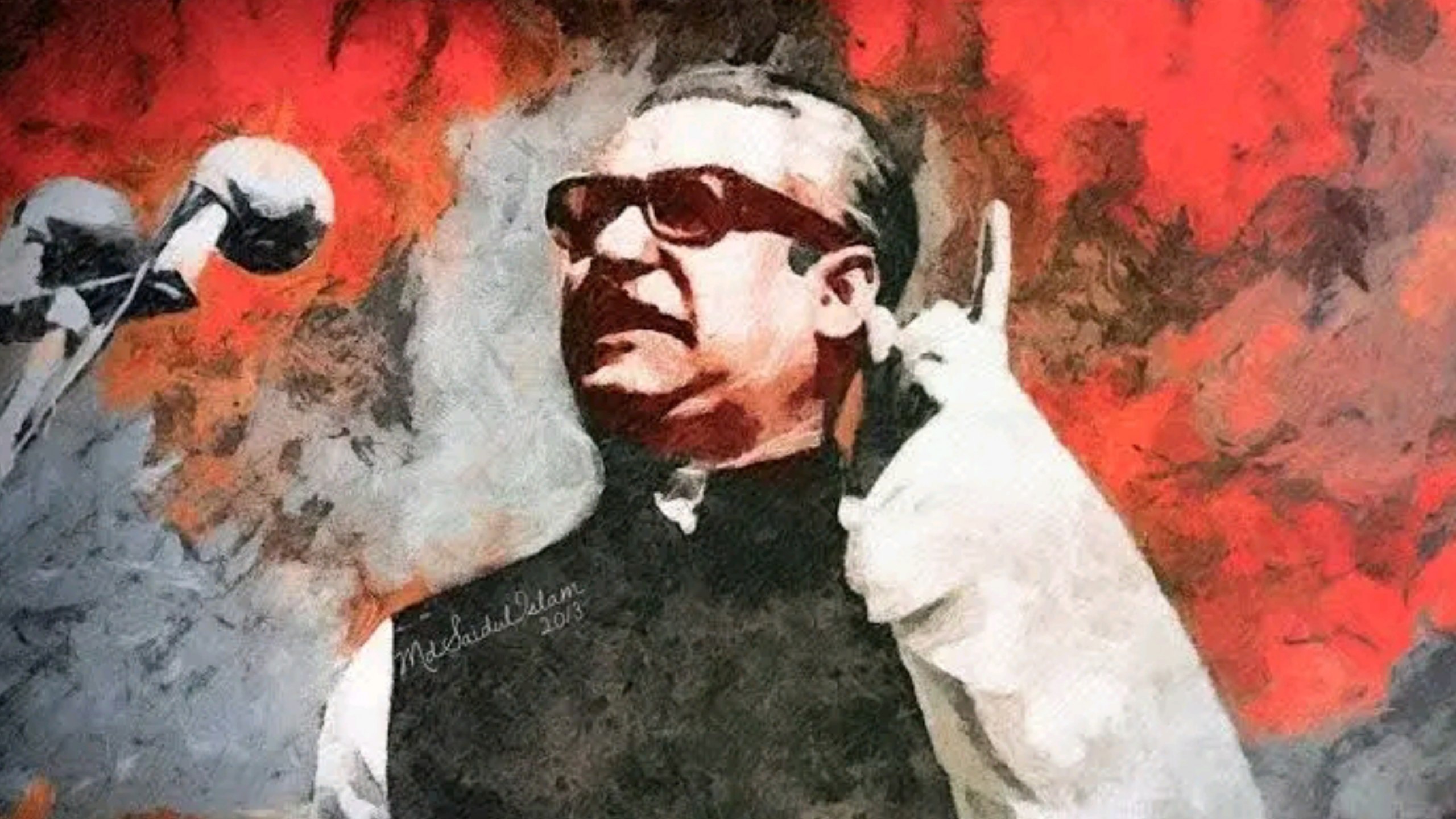
Fifty-one years ago, in the predawn hours of August 15, 1975, a group of army officers stormed the Dhanmondi Road 32 residence of Sheikh Mujibur Rahman and killed him along with nearly his entire family. His wife, three sons, including ten-year-old Sheikh Russell, daughters-in-law, brother, and several relatives died that night. Only his daughters Sheikh Hasina and Sheikh Rehana survived, both abroad at the time.
For decades, August 15 was marked in Bangladesh with official mourning, wreath-laying ceremonies, and speeches invoking his role as the architect of independence. This year, for the first time in the country’s post-2009 history, that ritual apparatus has largely fallen away, and what remains is a harder, more unsettled question: what does Bangabandhu’s legacy actually mean in a Bangladesh that has moved so far from the politics built in his name?
A Legacy Built On Independence
Sheikh Mujibur Rahman’s claim to the title Bangabandhu, Friend of Bengal, rests on ground few dispute. He co-founded the Awami League in 1949, led the movement for Bengali autonomy within Pakistan, and delivered the March 7, 1971 speech that is widely credited with galvanising the Liberation War.
His Six Point movement and his party’s landslide 1970 election victory, which the West Pakistani establishment refused to honour, set in motion the chain of events that led to Bangladesh’s independence. In a 2004 BBC poll, he was voted the Greatest Bengali of all time, a reflection of how deeply his role as founding father was embedded in the national imagination for much of the country’s history.
A Rule That Ended In Controversy
What is less comfortably discussed in ceremonial retellings is how his three and a half years in power unfolded. Facing famine, economic collapse, and political violence in the newly independent country, Mujib’s government moved toward increasingly centralised control, culminating in January 1975 with the establishment of BAKSAL, a one-party system that abolished the multi-party framework and consolidated power under a single national party.
Critics have long argued that this shift toward authoritarianism, whatever its stated justification, alienated significant parts of the political and military establishment and set the stage for the coup that killed him seven months later. Supporters counter that the move must be read against the extraordinary instability of the period, and that it says little about the man who had spent most of his political life fighting for democratic representation. Both readings persist in Bangladesh today, and neither has fully displaced the other.
A Legacy Now Entangled With Present Politics
What makes this particular anniversary different is how directly Mujib’s legacy has become entangled with the country’s current political rupture. Since the mass uprising that forced Sheikh Hasina, his daughter, to flee to India in August 2024, the interim and subsequently elected governments have systematically dismantled the institutional memory built around him. August 15 was stripped of its status as a national holiday in 2024.
School textbooks have been revised, his portrait removed from banknotes, and institutions bearing his name renamed. The Awami League itself, the party he founded, has had its registration suspended and its activities banned under anti-terrorism law, pending judicial proceedings, while Hasina faces an extradition request over her government’s deadly crackdown on the 2024 protests.
This year, dozens of Awami League activists were reportedly arrested in Dhaka for observing the day, with black clothing and mourning gatherings treated by authorities as a banned party’s activity rather than a national commemoration.
Separating The Man From The Movement
This is precisely why a phrase like “beyond rituals” matters. For nearly two decades, August 15 functioned largely as a state-choreographed ritual: official ceremonies, wreath-laying, speeches- that reinforced the Awami League’s political legitimacy as much as it honoured Mujib’s memory.
That ritual has now been dismantled, but dismantling it does not settle the underlying historical question
what Mujib’s founding role actually meant, separate from how successive governments, both his daughter’s and her successors’, have used or erased that memory for political ends.
Discover More Stories Worth Your Time
Explore What Follows Shahabuddin’s Exit?
Discover how Bangladesh’s leadership could change after the president’s departure.
Check Why Assault Case Filed?
Explore the allegations involving actress Snigdha Chowdhury and the Ashiyan chairman.
See How Microplastics Spread?
Discover why Bangladesh’s rivers, salt pans, and fish markets are raising concern.
Find Why Wetlands Face Threat?
Explore how invasive turtles are disrupting biodiversity in Dhaka’s waterways.
Learn Why Army Took Custody?
Discover the latest developments in the Brig Gen Miftah Uddin tribunal case.
Serious engagement with his legacy requires holding two things at once
that he was indispensable to Bangladesh’s creation as an independent nation, and that his final months in power raised legitimate questions about the direction of the state he had built, questions his family’s later decades in power did not fully resolve either.
What Fifty-One Years Later Actually Asks Of Bangladesh
Bangabandhu’s assassination remains, by any measure, a brutal act, the killing of a former head of state and most of his family, several of them children, in their own home. Mourning that act does not require endorsing every political use his image has been put to since, either by the party that once ruled in his name or by the government now working to erase it.
Fifty-one years on, the more honest tribute may not be another ceremony, official or banned, but a willingness to examine his founding role, his final years in power, and the four decades of political inheritance built on his name with the same clear eyes Bangladesh will need to navigate whatever comes next.