The headline numbers out of Bangladesh’s garment industry this year read like a warning. Exports to the European Union — historically the sector’s largest market — fell 19.4% year-on-year in the January-April period, the steepest decline among the EU’s major apparel suppliers. Overall RMG exports slipped 0.63% in the first half of 2026 to $19.34 billion, and garment shipments declined across 26 separate countries in the preceding six months. Buyers are reportedly planning to cut next-season work orders by 8-10%, citing unsold Western inventory and cautious restocking.
Layer onto that a genuine energy crisis. Gas pressure at mills across Narayanganj, Gazipur, and Savar has reportedly dropped low enough to push production down to 30-60% of capacity at some factories, and recurring two-to-three-hour power cuts have forced manufacturers toward costlier air freight just to meet shipping deadlines. Middle East shipping route disruptions have compounded the pressure on an industry that depends on predictable logistics to compete on price.
So is this a sector in decline? The picture is more complicated than the trade data alone suggests — and the answer depends heavily on which time horizon you’re looking at.
A Sector Under Real, Near-Term Strain
There’s no getting around the fact that 2026 has been a rough year operationally. The EU export slide is the sharpest signal: Bangladesh’s share of total EU apparel imports fell from 24.4% to 21.9% in early 2026, the largest market-share loss among the bloc’s leading suppliers. BGMEA’s own president has pointed to a combination of factors behind the slide — a volatile global trade environment, US reciprocal tariffs, high domestic bank interest rates, and port inefficiencies.
The energy crunch adds a layer of unpredictability that’s arguably more damaging than any single tariff policy, because it undermines the reliability that has historically been part of Bangladesh’s pitch to buyers. Competitors like Turkey have reportedly been gaining ground precisely because they offer steadier energy supply and shorter shipping distances to Western markets, even amid their own regional tensions.
There’s also a structural cost pressure that predates this year’s disruptions: minimum wages rose significantly in late 2023 and are expected to rise further, narrowing — though not eliminating — Bangladesh’s traditional low-cost labour advantage. Combined with heavy reliance on imported yarn and fabric from China, India, and Southeast Asia, the sector remains exposed to currency swings and supply shocks it doesn’t control.
The Case That This Is a Transition, Not a Collapse
Set against that near-term turbulence is a longer-run story that looks considerably steadier — and in some respects, genuinely ambitious.
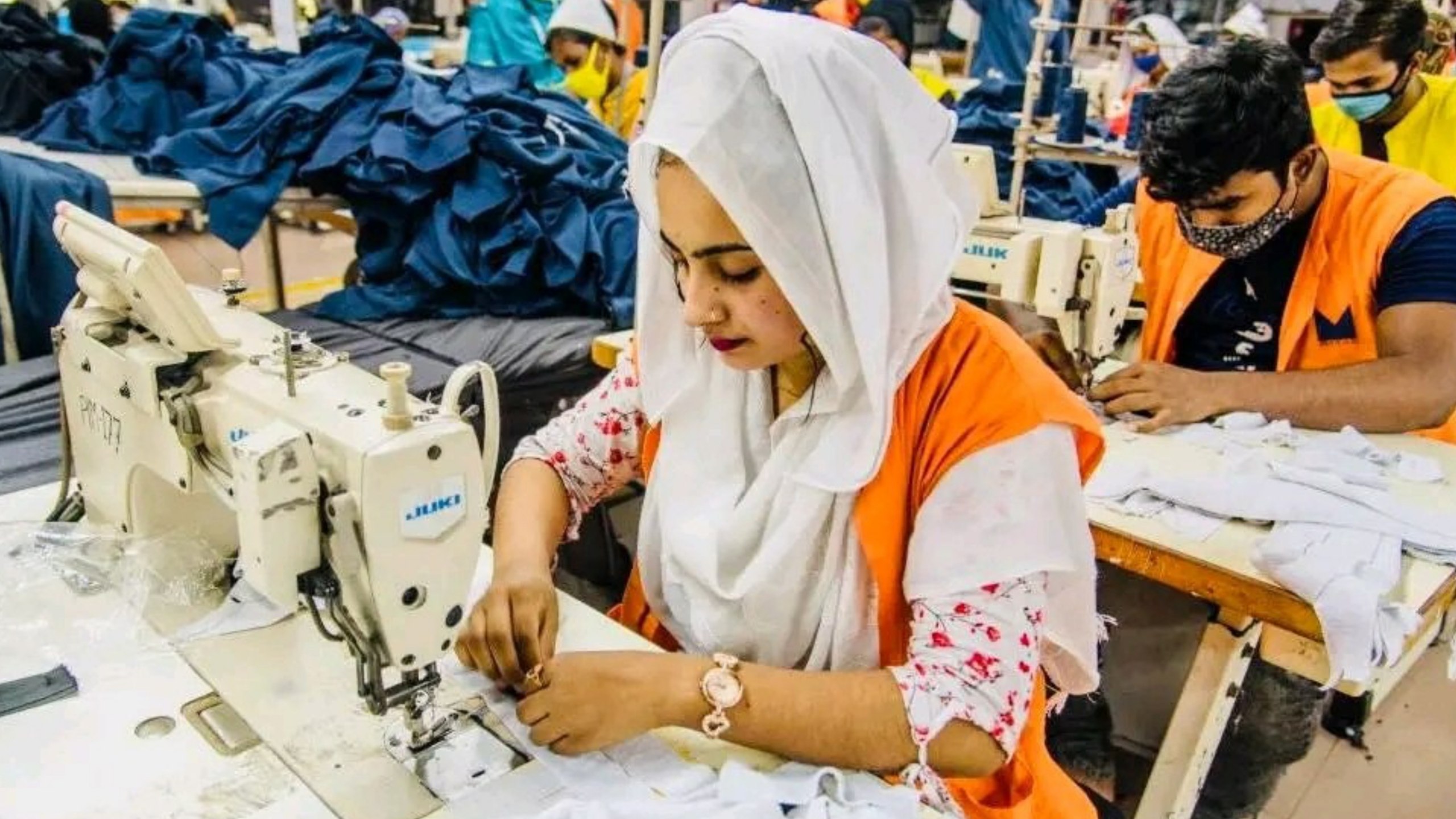
Bangladesh remains the world’s second-largest garment exporter, holding roughly 6.5% of global apparel market share, with the RMG sector still accounting for more than 80% of the country’s total export earnings and around 11% of GDP. It employs over 4 million workers, nearly 60% of them women, across more than 3,500 export-oriented factories — one of the most densely concentrated garment manufacturing clusters anywhere in the world.
On sustainability, Bangladesh isn’t playing catch-up — it’s setting the pace. The country hosts more LEED-certified green garment factories than any other nation, with figures cited around 226-230 certified facilities, including dozens at the top Platinum tier. That matters commercially, not just reputationally: as EU regulations like the Corporate Sustainability Due Diligence Directive tighten compliance requirements on apparel buyers, factories that have already invested in energy efficiency and certified green production are better positioned to retain — and potentially grow — orders from ESG-conscious brands.
There’s also a visible push toward higher-value production. Industry data points to expansion into denim, sportswear, and technical textiles — categories that carry better margins than basic commodity apparel and reduce Bangladesh’s exposure to the kind of price competition that low-cost rivals can win on volume alone. And with Bangladesh set to graduate from Least Developed Country status in November 2026, the sector is being pushed — by both government policy and necessity — to diversify export markets beyond its traditional EU-US-UK concentration, with analysts pointing to Latin America, Africa, East Asia, and the Middle East as underexploited growth regions.
Discover More Stories Worth Your Time
Explore Why Sundarbans Disappear?
Discover how climate change is threatening Bangladesh’s world-famous mangrove forest.
Check How Farmers Benefit?
Explore what the new Farmer’s Card means for growers in Rangpur and Rajshahi.
See Why President May Resign?
Discover the latest political developments surrounding President Shahabuddin’s future.
Find Why Flood Alert Issued?
Explore how a massive monsoon cloud band could affect Bangladesh’s weather.
Learn Which Bangla Series Watch?
Discover three homegrown Bangla web series perfect for your next weekend binge.
Explore Why Beef Turned Green?
Discover what the Khulna incident reveals about meat safety and food handling.
Where the Two Narratives Actually Meet
The “collapsing vs. waking up” framing sets up a binary that the data doesn’t really support. What’s happening looks less like collapse and more like a sector being forced to confront structural vulnerabilities it had previously been able to defer — cheap energy dependency, buyer concentration in two or three markets, and a low-cost labour model that was always going to have a shelf life.
The near-term numbers are genuinely bad, and factory owners and workers are living with real consequences right now — reduced hours, air-freight costs eating into already thin margins, and buyers hedging their orders. That’s not a story you can wave away with long-term optimism.
But the sector also isn’t starting this transition from a position of weakness. It has capital, buyer relationships built over decades, the largest green-manufacturing footprint in the industry, and a government treating diversification as a policy priority rather than an aspiration. Whether 2026 ends up looking like the year Bangladesh’s garment industry stumbled or the year it started rebuilding its foundations will likely depend less on this quarter’s export numbers and more on whether the energy crisis eases, whether the LDC graduation transition is managed without losing preferential trade access, and whether the push into new markets and higher-value products actually converts into diversified revenue rather than remaining a policy talking point.
For now, the more accurate read is probably: a sector under acute short-term stress, midway through a long-overdue structural pivot it can’t opt out of.
FAQ
Is Bangladesh’s RMG sector actually shrinking?
Overall exports dipped slightly in the first half of 2026, but the sharper declines are concentrated in the EU market specifically. It’s a slowdown and market-share loss more than an outright collapse.
What’s driving the current downturn?
A mix of factors — reduced Western buyer orders amid unsold inventory, a domestic energy crisis limiting factory output, rising freight costs, and broader global trade uncertainty including tariffs.
Why is Bangladesh still considered a leader in this space despite the downturn?
It holds the world’s largest number of LEED-certified green garment factories, remains the second-largest global apparel exporter, and is actively expanding into higher-value product categories like technical textiles and sportswear.
What role does LDC graduation play in this?
Bangladesh’s graduation from Least Developed Country status in November 2026 will affect the trade preferences it currently enjoys, adding urgency to efforts to diversify markets and upgrade production value.
Summary: Bangladesh’s ready-made garment sector — the backbone of its export economy — is sending mixed signals in 2026. Exports to the EU have fallen sharply, energy shortages and Middle East-linked shipping disruptions have cut factory output, and buyers are trimming next-season orders. At the same time, Bangladesh remains the world leader in LEED-certified green factories, is pushing into higher-value categories like technical textiles and sportswear, and is approaching LDC graduation with ambitions to diversify beyond its traditional US-EU buyer base. The sector isn’t collapsing outright, but it is being forced through a structural transition it can’t avoid.